Best Plus AI Alternatives in 2026: Top 8 AI Presentation Tools
I tested the best Plus AI alternatives to see which tools actually create presentation-ready decks. Here are the top AI presentation tools worth using in 2026.
Plus AI promises a simple outcome. You give it a prompt, and it turns that into a presentation inside Google Slides within minutes.
I’ve spent time testing it as part of a broader set of AI presentation tools, and it does deliver on speed. You get a first draft quickly, and at a glance, it feels usable.
But when you look at that output from a business presentation standpoint, it usually needs more work than expected. Getting from a generated draft to something you can confidently present still takes time, especially when structure, messaging, and audience context start to matter.
That’s where most teams begin exploring Plus AI alternatives.
If you’re here, you’re likely not looking for just another AI slide generator. You’re trying to find presentation software that helps you get to a clear, polished, and ready-to-use deck without spending hours refining it.
That’s the gap I focused on while putting this list together.
Here are the eight best Plus AI alternatives worth evaluating in 2026.
How I tested and selected these Plus AI alternatives
This isn’t a list pulled from feature pages or quick comparisons of AI presentation software.
I looked at these Plus AI alternatives in the context of real presentation workflows, where inputs are incomplete, requirements change, and the final output needs to hold up in a business setting.
The goal was straightforward. I wanted to identify AI presentation tools that reduce the total effort required to create a presentation, not just the time it takes to generate a first draft.
Here’s what I paid attention to:
Output quality in business presentations: Can the deck hold up in leadership reviews, client meetings, or internal strategy discussions without major rework?
Contextual accuracy: Does the AI-generated content reflect the audience, function, and objective, or does it stay generic?
Post-generation effort: How much time is needed to refine the AI-generated slides before they are ready to present?
Workflow integration: Does the tool fit into existing workflows like PowerPoint, Google Slides, and collaborative review processes?
Overall value: Does the pricing match the actual time saved and the quality of output delivered?
Let’s take a look at what stood out.
8 best Plus AI alternatives to try in 2026
If Plus AI works for quick drafts but starts to feel limited beyond that, it’s worth looking at other AI presentation tools that handle more of the workflow.
Different tools solve different parts of presentation creation. Some focus on speed, others on design control, and a few are built for teams that need consistent, business-ready output.
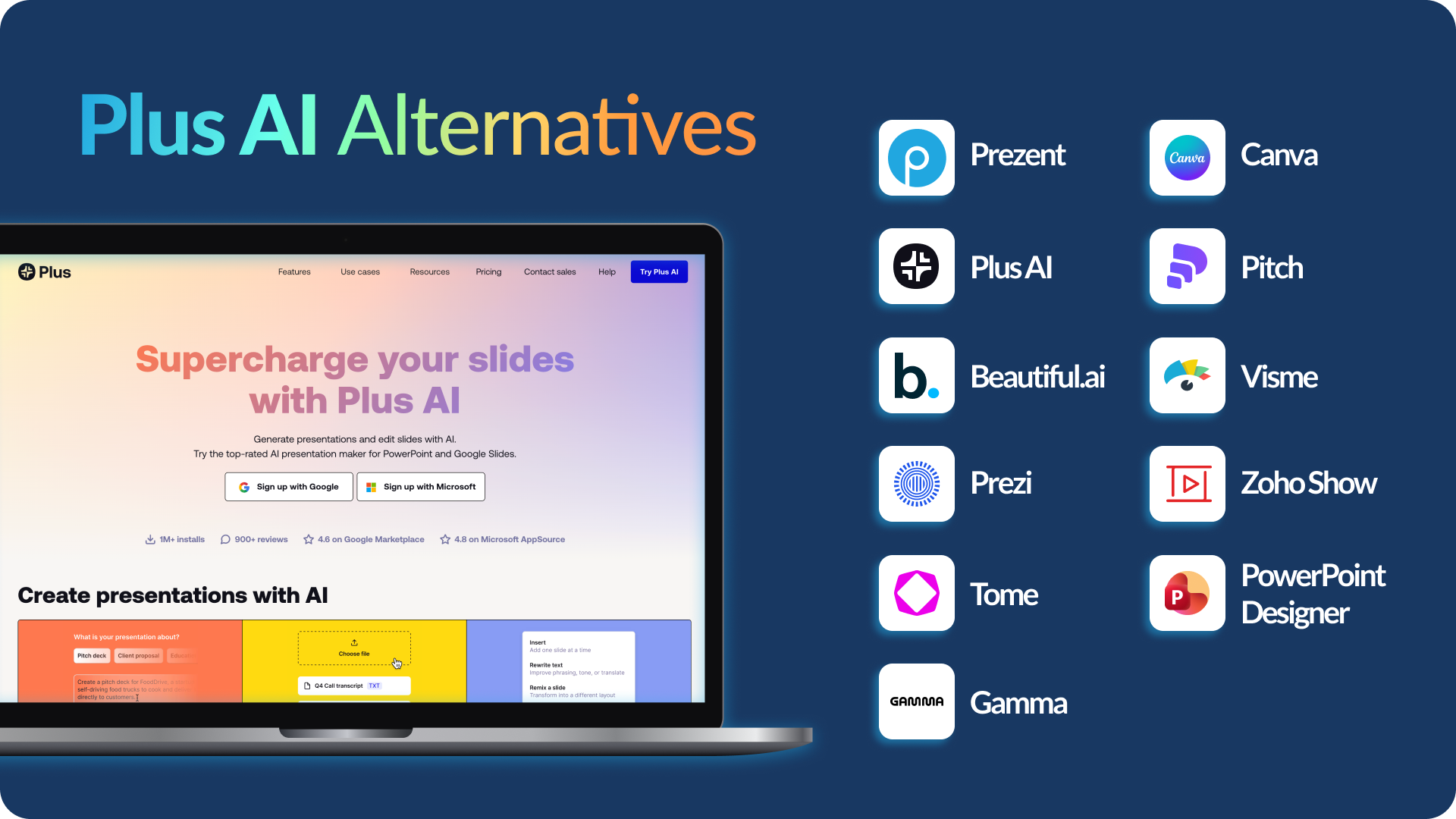
Here’s a quick comparison of the best Plus AI alternatives:
Each of these presentation tools approaches slide creation differently. The right choice depends on what you care about most, whether that’s faster drafts, better collaboration, stronger brand control, or higher-quality output for business presentations.
My picks for the 8 best Plus AI alternatives
1. Prezent AI: Best Plus AI alternative for enterprise teams
Prezent AI is one of the best Plus AI alternatives that feels built for real business communication, not just generating slides quickly.
If your team works on presentations like QBRs, launch reviews, executive summaries, or client-facing decks, this is where it stands out. It’s designed for situations where clarity, structure, and brand alignment actually matter.
What I found most useful is that it fits into a broader presentation workflow. You can take existing decks and transform the presentations into approved templates, create presentations for certain audience personas, and even request expert help. So it’s not just an AI slide generator, it’s closer to a system for managing how presentations are created and shared across an organization.
Key features for Prezent AI
Instead of relying only on prompts, it can take documents, notes, or data and turn them into structured, audience-aware presentations that feel closer to real business decks
Built-in brand controls ensure templates, layouts, fonts, and tone stay consistent across teams, reducing the need for manual cleanup
The slide library and story builder help teams reuse proven structures for recurring presentations like QBRs, strategy updates, and executive summaries
Template conversion makes it easier to bring older or externally created decks into approved formats without redesigning everything
Summary tools help condense long, detailed presentations into shorter versions that are easier for leadership to review
Access to expert services and coaching gives teams additional support for high-stakes presentations and helps improve communication quality
API support allows presentation creation to fit into existing workflows instead of becoming a separate process
What stood out to me
It removes a large part of the effort that usually comes after generating slides, especially when it comes to structure, formatting, and alignment
It works particularly well for teams that create presentations frequently and need them to follow a consistent standard every time
Adapting one presentation for different audiences feels easier, since you can adjust context instead of rebuilding from scratch
It supports more of the end-to-end presentation workflow, including transforming existing decks and summarizing content
It feels more like a long-term system for teams rather than a tool you use occasionally
What can be better
The structured approach can feel limiting if you prefer full creative control over layouts and slide design
It takes some time to get comfortable with the platform if you want to use its full capabilities
Making detailed edits within individual slides is not always as flexible as traditional presentation tools
For smaller teams or simple use cases, the platform may feel more extensive than necessary
Pricing
Prezent AI offers custom pricing for enterprise teams, along with a free trial and demo.
Prezent AI review: What real users say
G2 overall rating: 4.5/5 based on 114 reviews
Across most reviews, users consistently highlight how much easier it becomes to maintain brand consistency and reduce time spent on formatting. Many teams also mention that it helps shift their focus away from slide design and toward actual content and strategy.
“Aligning our brand guidelines across many verticals and users within our global organization has been a major part of why we use Prezent and what makes it a frequent source of slides and content. It is easy to use, simple to start and has been a key part of our acquisitions and their integrations as well to keep the branding consistent.” — Jeff A., Senior Marketing Strategist, Digital & Events, Mid-Market on G2
2. Beautiful.ai: Best Plus AI alternative for polished slides with minimal design effort
Beautiful.ai is a good fit if your main goal is to create clean, visually polished presentations without spending time on layout and formatting.
It’s one of those AI presentation tools where the value shows up immediately. You add content, and the slides adjust automatically. That alone removes a lot of the friction that usually comes with building decks in traditional presentation software.
From what I’ve seen, it works especially well for internal presentations, training decks, team updates, and general business presentations where consistency matters more than custom design.
Key features
The Smart Slides system automatically adjusts layout as you add or edit content, so you don’t have to fix alignment, spacing, or positioning manually
AI presentation builder can generate full decks from prompts, outlines, or uploaded content, giving you a structured starting point quickly
Built-in themes and brand controls allow you to define colors, fonts, and logos once, and apply them consistently across all slides
A large library of templates and visual assets helps you create professional-looking slides without relying on external design tools
AI assistance extends beyond generation, helping with rewriting text, creating visuals, and refining content within the same workflow
The platform is fully cloud-based, making it easy to access, edit, and share presentations across teams
What stood out to me
It removes most of the design effort from presentation creation, which is where a lot of time usually goes
Slides stay visually consistent even when content changes, so you don’t end up fixing layouts every time you edit something
It’s easy to get started, especially for users who don’t have strong design skills but still need professional-looking decks
Works well for repeatable, content-heavy presentations where structure and clarity matter more than creativity
Compared to many AI slide generators, the output tends to look cleaner right from the start
What can be better
The Smart Slides system can feel restrictive when you need very specific layouts or custom visual storytelling
Design flexibility is limited compared to tools like PowerPoint, especially for users who want pixel-level control
Exporting to PowerPoint can create formatting issues, which adds extra work if your workflow depends on it
Since it’s fully cloud-based, you need a reliable internet connection to work or present
Some users may find the visual style starts to feel repetitive across multiple presentations
Pricing
Beautiful.ai offers a Pro plan starting at around $12/month (billed annually), with team plans and enterprise pricing available depending on usage and team size
Beautiful.ai review: What real users say
G2 overall rating: 4.7/5 based on 192 reviews
Most users highlight how much time they save on design and formatting. The Smart Slides feature comes up frequently, especially for people who want clean, professional presentations without spending hours adjusting layouts.
At the same time, some reviews point out that the automation can feel limiting when you need more control over slide structure or want to create something more customized.
“I like the AI feature inside Beautiful.ai as it saves me a lot of time, allowing me to focus on content rather than graphics… The ability to create professional-looking presentations in under an hour is really helpful for me.” — Krzysztof P., Chief Executive Officer on G2
3. Prezi: Best Plus AI alternative for visual, non-linear storytelling
Prezi takes a completely different approach from most presentation software.
Instead of thinking in slides, you’re working on a single canvas where everything is connected. You can start with a big-picture view and then zoom into specific sections as you present. It changes how you structure your content from the beginning.
I found that this works best when you’re trying to explain something that has layers. A strategy, a process, a concept with multiple moving parts. Instead of breaking it into separate slides, you can show how everything fits together and move between ideas more naturally.
It’s not really trying to compete with AI slide generators on speed. It’s solving a different problem. It helps you present ideas in a way that feels more like a guided walkthrough than a sequence of slides.
Key features
The zoomable canvas lets you move between overview and detail without breaking the flow, which makes it easier to present layered ideas or complex topics
Content is organized spatially instead of sequentially, so you can design presentations around relationships between ideas rather than a fixed slide order
Prebuilt templates are structured for storytelling, helping you create a narrative-driven presentation without starting from scratch
Transitions are built into the experience, allowing you to guide attention smoothly instead of relying on standard slide changes
Works well in remote settings, especially when presenting over video, because the movement helps maintain audience attention
Being cloud-based, it allows for easy sharing, updates, and access across devices without worrying about file versions
What stood out to me
It changes how you think about presentations, not just how you design them
The ability to zoom in and out makes it easier to connect ideas and avoid the “disconnected slides” problem
It works particularly well when you’re explaining something, not just presenting information
Presentations feel more engaging because the format adds movement and direction
It stands apart from most AI presentation tools by offering a fundamentally different experience rather than incremental improvements
What can be better
It takes time to get comfortable with the canvas approach if you’re used to slide-based tools
It’s easy to overuse motion, which can make the presentation feel overwhelming instead of clear
It doesn’t offer the same level of control for highly structured or data-heavy presentations
Customization can feel limited compared to tools that allow full manual design
It may not fit well in formal business environments where traditional slides are expected
Pricing
Prezi offers a free plan, with paid plans starting at around $4 per month depending on features.
Prezi review: What real users say
G2 overall rating: 4.2/5 based on 5,248 reviews
A lot of users highlight how different and engaging the format feels, especially when they need to explain ideas rather than just present them. It’s commonly used in teaching, demos, and client-facing scenarios where holding attention matters.
At the same time, some reviews mention that the format isn’t always the best fit for formal or highly structured business presentations, and that the motion needs to be used carefully.
“Prezi gives us a dynamic, zooming canvas that fees so good that audience get connected and it feels more interactive for the presenter and the audience.” — Saksham J., Senior Business Travel Consultant (G2)
4. Gamma: Best Plus AI alternative for quickly turning ideas into structured presentations
Gamma is one of the fastest ways I’ve seen to go from a rough idea to a structured presentation.
You don’t really “build” slides in the traditional sense. You give it a prompt, an outline, or even a messy set of notes, and it turns that into a clean, readable draft within minutes. That makes it especially useful when you’re starting from scratch and don’t want to think about structure right away.
What stood out to me is how it handles that early stage of presentation creation. When you’re staring at a blank deck and don’t know how to organize your thoughts, Gamma gives you something to react to instead of something to build from zero.
That said, it’s very much focused on getting you to a strong first version. You’ll still need to refine the content if the presentation is meant for a more formal or external setting.
Key features
Prompt-based generation lets you turn rough ideas, notes, or documents into a structured presentation without manually organizing content
Automatically breaks content into sections and flows, which helps when your input is unstructured or incomplete
Uses a clean, card-based layout that feels more like a modern document than a traditional slide deck
Built-in support for images, videos, and visuals makes it easy to add context without switching tools
Real-time editing and collaboration allow teams to review and refine content together
Flexible editing after generation means you can adjust text, layout, and structure instead of being locked into the initial output
What stood out to me
It removes the “where do I start” problem by giving you a structured draft almost instantly
Works especially well when your input is messy or not fully thought through
The interface is simple enough that you don’t need onboarding to start using it
It fits naturally into workflows where presentations are created frequently and quickly
It’s one of the more practical AI presentation tools for internal decks, proposals, and quick updates
What can be better
The generated content can feel generic, especially for domain-specific or specialized topics
You’ll likely need to refine the messaging before using it in client-facing or high-stakes presentations
Visual elements sometimes need adjustment to meet professional standards
Customization options are limited compared to traditional presentation software
The credit-based pricing model can make iteration harder if you’re experimenting with multiple versions
Pricing
Gamma offers a free plan, with paid plans typically starting between $8 per month depending on usage and features.
Gamma review: What real users say
G2 overall rating: 4.1/5 based on 23 reviews
Most users highlight how quickly Gamma turns ideas into usable presentations. It’s often described as a strong starting point, especially for internal work, proposals, or situations where speed matters.
At the same time, reviews mention that the content can feel a bit generic and usually needs refinement before being shared externally.
“I like Gamma AI because it quickly turns ideas or outlines into polished presentations, documents, or simple webpages without needing design skills.” — Kamal R., Business Analyst (G2)
5. Canva: Best Plus AI alternative for fast, visual-first presentations
Canva is not built purely as a presentation tool, and that’s exactly why it works for so many teams.
It’s designed for creating all kinds of visual content, and presentations are just one part of that. If your workflow already includes things like social posts, reports, or internal documents, Canva fits in naturally without needing a separate tool.
From my experience, Canva works best when speed and visual quality matter more than structure or deep customization. You can start with a template, drop in your content, and get to a clean, polished presentation quickly without spending time adjusting layouts.
That’s also why it’s widely used across marketing, HR, sales, and internal teams. It lowers the barrier to creating presentations, especially for people who are not designers.
Key features
Drag-and-drop editor makes it easy to build presentations without needing design experience, which helps teams move quickly from idea to finished slides
Large template and asset library provides ready-to-use layouts, images, icons, and fonts for a wide range of presentation styles
Brand kits allow teams to define colors, fonts, and logos once and apply them consistently across all presentations
AI-powered tools like Magic Resize and content suggestions help speed up repetitive tasks and simplify edits
Built-in media tools such as background remover and image editing reduce the need for separate design software
Real-time collaboration allows multiple users to edit, comment, and share presentations without version conflicts
What stood out to me
It makes presentation creation accessible to almost anyone, regardless of design experience
You can go from idea to a visually polished deck very quickly, especially for internal presentations or quick updates
It fits into a broader content workflow, so you’re not switching between multiple tools for different formats
The template library helps maintain a consistent look without needing strict design guidelines
It’s one of the easiest tools to use among all AI presentation tools and presentation software
What can be better
Customization can feel limited when you need precise layouts or more structured, data-heavy presentations
Many presentations can start to look similar if teams rely heavily on the same templates
It’s not ideal for complex storytelling or highly structured business presentations
Some premium templates and assets are only available in paid plans
Collaboration can occasionally feel inconsistent when multiple users are editing at the same time
Pricing
Canva offers a free plan, with Canva Pro starting around $15 per month and team plans available for businesses.
Canva review: What real users say
G2 overall rating: 4.7/5 based on 6,900+ reviews
Reviews on G2 frequently mention how easy Canva is to use and how quickly they can create polished visual content. It’s especially popular among non-designers who still want professional-looking presentations.
“The drag-and-drop interface and wide range of templates allow me to produce polished content quickly without needing advanced design skills.” — Jeanille R., Technical Recruiter, on G2
6. Pitch: Best Plus AI alternative for investor-style presentations and startup teams
Pitch is one of the few presentation tools that feels naturally aligned with how startup and investor decks are built.
Instead of focusing on heavy design or deep customization, it leans into clarity, structure, and quick iteration. That works well in investor presentations, where the goal is to communicate an idea clearly and keep refining it as feedback comes in.
The workflow also reflects this. You’re not building a static deck and sending it around. You’re working on something that keeps evolving, with multiple people contributing and reviewing along the way.
It’s not trying to replace full-scale presentation software. It’s more focused on helping teams create, refine, and share concise, narrative-driven decks.
Key features
Designed for concise, narrative-style presentations, which fits well with investor decks that need to communicate ideas clearly and quickly
Real-time collaboration allows founders, team members, and stakeholders to work on the same deck without version confusion
Structured templates help guide storytelling and keep slides focused instead of overloaded
AI support assists with drafting and refining content when starting from rough ideas or outlines
Presentations can be shared as live links, making it easier to keep decks updated without resending files
Engagement analytics show how viewers interact with the deck, which can be useful when sharing with external audiences
Integrations with tools like Slack, Notion, and Loom help connect presentations with ongoing team workflows
The structure encourages clarity and brevity, which is important for this type of deck
Collaboration feels seamless, especially when multiple people are refining the same presentation
Sharing via links makes it easier to keep a single, updated version instead of managing files
The overall workflow feels fast and lightweight, which suits startup environments
What can be better
It doesn’t offer the same level of design flexibility as more advanced presentation tools
The structured approach can feel limiting if you want highly customized layouts
Since it’s browser-based, it depends on a stable internet connection
Some advanced features are only available in higher-tier plans
It may not be the best fit for presentations that require detailed structure or heavy data
Pricing
Pitch offers a free plan, with paid plans starting at around $13 per user per month, and custom pricing for enterprise teams.
Pitch review: What real users say
G2 overall rating: 4.4/5
Many users highlight how well Pitch supports collaborative workflows and how easy it is to build clean, structured presentations quickly. The templates and interface are often mentioned as particularly useful for keeping decks simple and focused.
“It's so easy to use, the templates are also nice, once I set it, my teammates are able to just use the template and make it a default.” — Anne K, Strategy Operations, on G2
7. Visme: Best Plus AI alternative for data-heavy presentations and visual storytelling
Visme stands out when presentations start to look more like reports.
Most AI presentation tools focus on speed and structure. They help you get a draft quickly, but they don’t always handle detailed or data-heavy content well. That’s where Visme takes a different direction.
It’s built to handle charts, infographics, and more visual forms of communication. So instead of simplifying everything into basic slides, it gives you the ability to present information in a more detailed and structured way.
From what I’ve seen, it’s less about generating a quick deck and more about building something that explains the content clearly. That makes it a better fit when the presentation needs to carry more information than usual.
Key features
Offers strong data visualization capabilities, making it easier to present charts, comparisons, and structured information clearly
Supports multiple formats including presentations, reports, infographics, and dashboards, which adds flexibility beyond standard slides
Includes interactive elements like animations and clickable sections that can make presentations more engaging
Provides more control over layouts and visual structure compared to simpler, template-driven tools
Includes brand management features to maintain consistency across different types of content
Allows teams to collaborate and share content without relying on static files
What stood out to me
It handles information-heavy presentations better than most tools in this category
The focus is on clarity and explanation rather than just slide generation
It gives more flexibility in how content is structured and presented
It works well when the presentation needs to feel more like a report or analysis
It sits somewhere between a design tool and presentation software
What can be better
It’s not built for speed, so creating presentations can take longer compared to AI-first tools
The interface can feel complex when you first start using it
There’s a learning curve if you want to take full advantage of advanced features
Some features are limited to higher-tier plans
It may feel unnecessary for simpler presentations
Pricing
Visme offers a free plan, with paid plans starting at around $12.25 per month, along with business and enterprise pricing options.
Visme review: What real users say
G2 overall rating: 4.5/5
Users highlight how useful Visme is for creating detailed, visually rich presentations, especially when working with charts, infographics, or reports. It’s often seen as a stronger option when the goal is to explain information clearly.
However, some users mention that the platform can feel complex at first and may take time to fully get comfortable with.
“I love the clean, polished, professional designs available in Visme—they help me make the best impression on my audience.” — Debra R., SR. Hr Generalist, on G2
8. Zoho Show: Best Plus AI alternative for teams already using Zoho apps
If you already use Zoho apps, Zoho Show is one of the easiest presentation tools to adopt.
On its own, Zoho Show is a cloud-based presentation software with all the expected features. You can create slides, add visuals, collaborate, and present. But where it becomes more useful is when those presentations are connected to the rest of your tools.
For example, instead of pulling data manually or switching between platforms, you can work within the same environment where your data, documents, and workflows already exist. That reduces a lot of small friction points that usually go unnoticed but add up over time.
It also keeps things simple. The interface is minimal, and the feature set is focused on what most teams actually need, not everything they could use.
Key features
Built to work inside the Zoho ecosystem, which means presentations can connect with tools like CRM, analytics, and documents without switching platforms
Fully cloud-based, so you can create, edit, and present from any device without worrying about file versions or installations
Real-time collaboration allows multiple people to work on the same presentation, with changes reflected instantly instead of managing multiple files
Includes a library of templates and themes that help you get to a clean, professional-looking deck without starting from scratch
Supports charts, diagrams, and multimedia like audio and video directly inside the editor, so you don’t need external tools for basic visuals
Lets you publish, embed, or broadcast presentations, which is useful when sharing beyond your immediate team
Compatible with PowerPoint formats, so you can import and export files without breaking your workflow
What stood out to me
It feels practical more than impressive, which actually works in its favor
The integration with Zoho apps reduces a lot of small manual steps in day-to-day workflows
Collaboration is straightforward and doesn’t require extra setup or tools
The interface stays out of your way, so you can focus on building the presentation instead of figuring out features
It works well as part of a larger system rather than as a standalone tool
What can be better
It doesn’t push ahead on AI presentation features the way newer tools do
Design flexibility is more limited compared to tools like PowerPoint or Canva
The templates are functional, but not as visually strong as design-first tools
If you’re not already using Zoho, the value drops significantly
It’s not built for highly customized or visually complex presentations
Pricing
Zoho Show is free for individual use.
Zoho Show review: What real users say
G2 overall rating: 4.4/5
Most users highlight how easy it is to use and how well it fits into existing workflows, especially for teams already using Zoho products. The ability to collaborate in real time without dealing with multiple versions is also frequently mentioned.
At the same time, some users note that while it’s reliable and practical, it doesn’t offer the same level of design flexibility or advanced features as other presentation software.
“I appreciate how user-friendly this software is for crafting various types of presentations, be it for business or any other purpose. Right from the get-go, it offers a wide array of templates, alongside excellent typography and color choices.” — Manisha G., Senior Business Development Strategist, on G2
Final thoughts: choosing the right Plus AI alternative for your workflow
The best Plus AI alternative depends on what you actually need. Some tools help you generate slides faster. Others focus on design, collaboration, or specific formats. But most still leave you with a draft that needs work.
If your goal is to get to a presentation that’s actually ready to use, the gap becomes obvious.
That’s where Prezent AI stands out. It focuses on transforming content into business-ready presentations, not just generating slides.
Astrid AI turns documents, notes, or data into structured presentations with clear flow
Adapts messaging based on audience, industry, and context so it doesn’t feel generic
Applies brand guidelines automatically across slides without manual formatting
Transforms existing decks into cleaner, more consistent versions
Frequently asked questions about Plus AI alternatives
1. What are the best Plus AI alternatives in 2026?
Some of the best Plus AI alternatives include tools like Prezent AI, Beautiful.ai, Gamma, Canva, Pitch, and Prezi. Each tool focuses on a different part of the presentation workflow, such as AI slide generation, design, collaboration, or storytelling.
2. Why do people look for Plus AI alternatives?
Most teams start exploring Plus AI alternatives when they need more than just a quick draft. While Plus AI is fast, the output often requires additional editing to make it presentation-ready, especially for business use cases .
3. Which AI presentation tool is best for business presentations?
For business presentations, tools that focus on structure, brand consistency, and audience context tend to work better. Platforms like Prezent AI are designed to help teams create more polished, ready-to-use presentations with less manual effort.
4. Are AI presentation tools better than PowerPoint or Google Slides?
AI presentation tools are not necessarily replacements but additions. They help with generating and structuring content faster, while tools like PowerPoint or Google Slides are good for manual editing and customization.
5. How do I choose the right Plus AI alternative?
Start by identifying what you need most. If speed is your priority, AI slide generators like Gamma work well. If design matters, Canva or Beautiful.ai are good options. If you want to reduce editing and create more structured, business-ready presentations, tools like Prezent AI are a better fit.
Niyati is a Content Marketing Specialist with over 5 years of experience creating product-led content that drives conversions. She focuses on building high-intent, search-driven content that aligns closely with product value and turns traffic into users. Having worked with several SaaS and AI-first companies, she specializes in bridging content strategy with measurable growth.
10 Best PopAI alternatives: Compare features, AI capabilities, pricing, and free plans
Find the best PopAI alternatives and AI presentation makers. Compare AI features, pricing, and free plans to create smarter, more professional presentations.
Nano Banana review: Evaluating strengths, workflow gaps, and AI solutions for enterprise presentations
Nano Banana review for enterprise presentations. Explore visual strengths, identify workflow gaps, and see how teams use AI to build faster, executive-ready presentations.
11 Best SlideShare Alternatives for Sharing Presentations
Explore the best SlideShare alternatives for creating and sharing presentations. Compare tools for hosting, collaboration, design, and presentation analytics.
An in-depth Beautiful.ai review covering features, pricing, pros, and limitations to help you decide if it’s the right presentation tool for your needs.
15 Best AI Automation Tools for Workflow Automation in 2026
Explore the best AI automation tools in 2026. Compare platforms for workflow automation, content creation, and business operations to boost productivity.
Explore the best Adobe alternatives in 2026. Compare tools for design, presentations, and photo editing that help you create faster without complexity.
9 Best Slidesgo Alternatives for Better Presentation Templates (2026)
Explore the best Slidesgo alternatives for presentation templates and design. Compare tools that help you create structured, on-brand presentations faster.