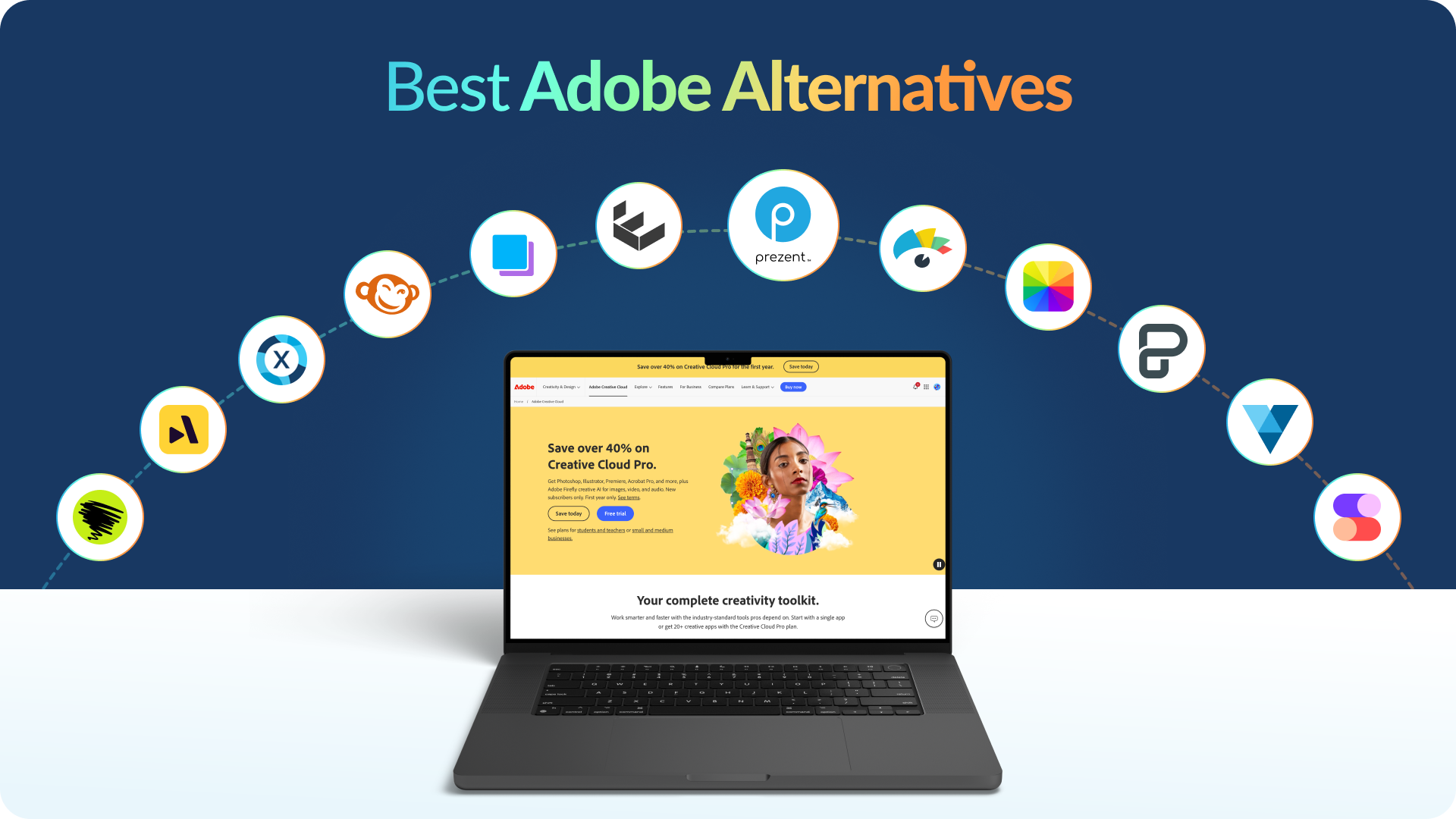
Explore the best Adobe alternatives in 2026. Compare tools for design, presentations, and photo editing that help you create faster without complexity.
If you’ve ever felt overwhelmed by Adobe’s complexity or frustrated by its pricing, you’re definitely not alone.
I’ve been there too: opening a tool like Photoshop or Premiere Pro for what should’ve been a quick edit, only to spend way more time navigating menus than actually creating something useful.
Over time, as I started exploring newer tools, especially AI-powered ones, I realized something important: not everyone needs the full power of Adobe.
Most of us just want tools that help us create good-looking visuals, presentations, or marketing assets quickly, without a steep learning curve or expensive subscriptions.
That’s exactly why I’ve created this list. In this guide, I’ve tested and reviewed a wide range of tools to find the best Adobe alternatives in 2026, both free and paid, so you can choose something that actually fits your workflow.
What is Adobe?
Adobe is a software company that provides a suite of creative tools used for designing, editing, and producing digital content.
It is one of the most well-known names in creative software, and for good reason.
Its Creative Cloud suite includes tools like Photoshop (for image editing), Illustrator (for vector design), Premiere Pro (for video editing), and InDesign (for layouts and publishing).
When I need pixel-perfect control or highly detailed creative work, Adobe still stands out. It’s powerful, precise, and trusted by professionals across industries.
But it feels a little too much for simple design requirements, and has a steep learning curve which is difficult for beginners including me.
It can also feel like an overkill for business teams, marketers, or quick-turnaround work.
Why look for Adobe alternatives?
Here are the biggest reasons people start looking for alternatives:
High cost: Adobe subscriptions add up quickly, especially if you need multiple apps.
Steep learning curve: Even basic tasks can take time if you’re not deeply familiar with the tools.
Overkill for everyday work: For simple graphics, presentations, or social media posts, Adobe often feels too heavy.
Resource-intensive: Some tools require strong hardware, which isn’t always practical.
Team collaboration gaps: While Adobe has improved here, many newer tools feel more collaborative by default.
Layer editing, AI tools, filters, browser-based editing, quick interface
Free plan available; paid plans start at $2.90/month
How I chose these Adobe alternatives
When I evaluated Adobe alternatives, I focused on how well each tool fits into real, everyday workflows rather than just how many features it offers. In my experience, the best tools are the ones that help you move faster and reduce manual effort.
Here’s what I looked at while testing:
Functionality: Whether the tool delivers on its core use case, like creating presentations, editing images, or designing visuals without gaps.
Ease of use: How intuitive the interface feels and how quickly I could go from a blank canvas to a usable output.
Value for money: Whether the pricing makes sense for the features offered, especially compared to Adobe’s subscription costs.
Customer support: The quality of help docs, tutorials, and responsiveness when you get stuck.
Integrations: How well the tool works with existing workflows like PowerPoint, Google Workspace, or other business tools.
Scalability: Whether it can support not just individual use but also growing teams with collaboration and brand needs.
I also tested most of these tools myself to identify the ones that reduce friction, save time, and make creative work more accessible.
Top Adobe alternatives I recommend
After testing a wide range of tools, one thing became clear to me: there’s no single “Adobe replacement.” Each tool solves a different part of the workflow: presentations, design, photo editing, video, or AI visuals.
So instead of trying to find a one-size-fits-all option, I focused on tools that do specific things really well and actually make day-to-day work easier.
Here are the Adobe alternatives I recommend for 2026:
1. Prezent AI: Best AI-powered Adobe alternative for business presentations
Most Adobe tools and even most alternatives focus on helping you only design slides. Prezent AI focuses on helping you communicate clearly and stay on brand while also letting you create visually-appealing presentations. It brings together AI, business context, brand governance, and storytelling into one platform.
Prezent AI removes the need to start from scratch. I can take a prompt, a document, or even rough notes and turn them into a structured, on-brand presentation within minutes.
And this is not generic AI output. The platform understands industry context and business language, so the slides feel relevant and ready for real use.
Key features
AI-powered presentation generation: Converts prompts, documents, files, or links into structured, business-ready decks with clear flow and messaging
Context-aware personalization (Astrid AI): Adapts content based on industry, function, company, and audience type
Built-in brand compliance: Applies brand guidelines across fonts, layouts, and messaging automatically
Story builder and business frameworks: Uses proven presentation structures to organize content, not just design slides
Content transformation tools: Converts old decks into on-brand formats, generates executive summaries, and refines messaging
Collaboration and shared libraries: Enables teams to reuse approved slides and maintain consistency across presentations
Expert services layer: Offers access to overnight presentation support and strategic input when needed
Pros
Removes the need for manual slide creation and formatting, which significantly reduces time spent on presentations
Ensures brand consistency across teams without requiring constant reviews or corrections
Improves not just design but also structure and storytelling, which is where most presentations fall short
Combines AI, templates, and expert support into one workflow, making it more comprehensive than typical design tools
Works well for high-stakes business use cases like leadership reviews, client presentations, and QBRs
Cons
Not suitable for detailed creative work like image editing, illustration, or video production
Limited flexibility if you prefer full manual control over every design element
Most valuable for teams and business environments rather than occasional individual use
Pricing
Prezent AI offers custom enterprise pricing along with a 14-day free trial
My take
If presentations are a core part of your work, Prezent AI is the most effective Adobe alternative I would recommend.
It shifts the focus from design effort to clear communication, brand consistency, and speed. That is something traditional design tools do not solve well.
2. Visme: Best for all-in-one visual content and data storytelling
Visme is the tool that’s fit for more than just presentations.
Unlike Adobe, where you often have to switch between multiple apps for different types of content, Visme brings everything into one place. I can create presentations, infographics, reports, dashboards, and even interactive content without leaving the platform.
What stands out to me is how well it handles information-heavy content. If your work involves explaining data, building reports, or creating structured visual communication, Visme makes that process much easier and more organized.
Key features
All-in-one visual content platform: Create presentations, infographics, reports, dashboards, and even social graphics from a single workspace
AI presentation and design generation: Generate full slide decks and visual layouts from simple prompts, reducing the need to start from scratch
Advanced data visualization tools: Built-in charts, graphs, widgets, and dashboards help turn raw data into clear, visual insights
Extensive template and slide library: Access hundreds of templates and 900+ slide layouts that can be mixed and customized easily
Brand kit and asset management: Apply brand colors, fonts, and logos consistently across all projects
Interactive and animated content: Add hover effects, clickable elements, and animations to make content more engaging
Built-in asset library: Millions of stock images, icons, and media elements available directly inside the editor
Pros
Gives you a single platform for multiple content types, which reduces the need to juggle between different tools like Adobe apps
Strong at turning complex data into clear, visual formats, making it ideal for reports, dashboards, and presentations
AI features and templates help speed up the initial creation process, especially when you are starting from scratch
Offers enough flexibility to customize designs without becoming as complex or overwhelming as Adobe tools
Cons
The interface can feel slightly heavy at first, especially if you are used to simpler tools like Canva
Some of the most valuable features, like advanced exports, brand kits, and full asset access, are locked behind higher-tier plans
Not the fastest option for quick, lightweight tasks since it is built for more structured and detailed content
AI output quality can depend on how clearly you define your input or prompt
Pricing
Visme offers a free plan, with paid plans starting at $12.25 per user per month.
My take
If you are looking for a single tool that can handle presentations, reports, and visual content at scale, Visme is one of the strongest Adobe alternatives.
It is not the fastest tool for quick designs, but when clarity, structure, and data storytelling matter, it gives you far more depth than most simpler tools.
3. Fotor: Best for quick AI-powered photo editing
Fotor is the tool that helps edit images quickly without getting pulled into a heavy workflow.
With Adobe tools like Photoshop, even simple edits can turn into a multi-step process. Fotor simplifies that completely. It’s built for speed and accessibility, which means you can go from a raw image to something usable in minutes, not hours.
What I find especially useful is how much it relies on AI to remove manual effort. Instead of adjusting every setting yourself, you can enhance images, remove backgrounds, or retouch photos with a single click and still get clean, usable results.
Key features
AI photo enhancement: Automatically adjusts brightness, contrast, sharpness, and colors to improve image quality without manual tuning
AI background removal and object removal: Cleanly removes backgrounds or unwanted elements, which is especially useful for product images and social content
AI retouching tools: Includes skin smoothing, blemish removal, and portrait enhancements for quick edits
Batch editing capabilities: Apply the same edits across multiple images, which helps when working with large sets of visuals
Design templates and collage maker: Create social media posts, banners, and simple graphics alongside photo editing
Filters and visual effects library: Wide range of presets that help you quickly style images without starting from scratch
Cross-platform access: Works in browser, desktop, and mobile, making it easy to edit on the go
Pros
Makes image editing extremely fast and accessible, even for users with no design experience
AI tools handle most common editing tasks, which reduces the need for manual adjustments
Much lighter and easier to use compared to Adobe tools, especially for everyday content creation
Works well for social media, marketing visuals, and quick turnaround tasks
Affordable pricing with a functional free plan
Cons
Lacks depth for advanced editing, such as detailed layer manipulation or precision control
Not suitable for professional design workflows that require high customization
Limited collaboration and team features compared to other tools on this list
Heavily template and preset-driven, which can limit creative flexibility over time
Pricing
Fotor offers a free plan, with paid plans starting at $8.99 per month, unlocking advanced AI tools, premium assets, and higher export quality.
My take
Fotor is a strong Adobe alternative when speed is the priority. I use it for quick edits, social content, and bulk image work where spending time inside Photoshop simply isn’t worth it.
4. Piktochart: Best for infographics, reports, and data-driven visuals
Piktochart is the tool I recommend when the goal is not just to design something, but to explain something clearly.
With Adobe tools, you often start with a blank canvas and build everything from scratch. Piktochart takes a more structured approach. It gives you ready-made formats for reports, infographics, and presentations similar to Prezent AI, so you can focus on organizing information instead of figuring out layouts.
The templates are not just visually designed, they are content-driven. They help you break down information into sections that are easier to read and understand.
Key features
Infographic and report builder: Create structured visuals for reports, case studies, presentations, and summaries
Drag-and-drop editor: Simple interface that allows you to customize layouts without needing design skills
Data visualization tools: Built-in charts, graphs, icons, and maps that integrate directly into your visuals
Multiple content formats: Supports infographics, presentations, reports, social graphics, and print-ready documents
Team collaboration features: Shared workspaces, commenting, and editing for team-based workflows
Template-driven workflows: Hundreds of templates designed specifically for business, education, and marketing use cases
Branding tools: Maintain consistent fonts, colors, and logos across projects
Pros
Makes it significantly easier to turn complex data or information into clear, structured visuals
Templates guide both design and content flow, which is helpful for non-designers
Strong focus on real-world use cases like reports, dashboards, and presentations
Collaboration features make it practical for teams working on shared content
Faster than Adobe for structured, information-heavy outputs
Cons
Limited AI capabilities compared to newer tools that automate content generation
Less flexibility for highly creative or custom design work
Template styles can start to feel repetitive if used frequently
Not suitable for advanced graphic design, illustration, or branding work
Pricing
Piktochart offers a free plan with basic features, with paid plans starting at $14 per month, unlocking more templates, downloads, and collaboration capabilities.
My take
Piktochart is a practical Adobe alternative when clarity matters more than creativity. I rely on it for reports and infographics where the goal is to communicate information clearly, not experiment with design.
5. Easil: Best for branded social media and marketing visuals
Easil is one of those tools that’s built very intentionally for teams that care about brand consistency but don’t want to depend on designers for every small task.
When I used it, what stood out immediately was how structured everything feels around branding. Unlike Adobe, where you have full freedom but also full responsibility, Easil gives you controlled flexibility. You can create designs, but within guardrails that keep everything on brand.
This is especially useful for marketing teams where multiple people are creating content regularly.
Key features
Brand kit and style controls: Store logos, fonts, and colors and apply them consistently across all designs
Template locking: Lock specific elements in templates so team members can edit content without breaking design structure
Drag-and-drop editor: Simple interface for creating social posts, banners, and marketing visuals
Text effects and design tools: Built-in text animations, overlays, and styling options without needing advanced design skills
Team collaboration and permissions: Assign roles and control who can edit what within a design
Template library: Hundreds of ready-to-use templates for social media, ads, and marketing assets
Layer-based editing: Offers more control than basic tools, without becoming as complex as Adobe
Pros
Strong focus on brand consistency, which makes it ideal for teams producing high volumes of content
Template locking is extremely useful for maintaining design quality across non-designers
Easier to use than Adobe tools while still offering more structure than very basic editors
Well-suited for social media, ads, and recurring marketing content
Helps reduce dependency on design teams for everyday visuals
Cons
Limited AI capabilities compared to newer tools that automate content creation
Not suitable for presentations, data-heavy content, or complex visual storytelling
Design flexibility is restricted compared to Adobe, especially for custom or creative work
Template styles can feel repetitive over time
Pricing
Easil offers a free plan, with paid plans starting at $7.50 per month, unlocking advanced templates, brand controls, and team features.
My take
Easil is a practical Adobe alternative for marketing teams that need to produce consistent, on-brand visuals quickly. I see it as a tool that balances control and simplicity without overwhelming the user.
6. Snappa: Best for simple, fast graphic creation
Snappa is one of the simplest tools on this list, and that simplicity is exactly what makes it useful.
When I used it, the biggest advantage was how quickly I could create something usable. There’s almost no learning curve. You pick a template, make a few edits, and you’re done.
Compared to Adobe, where even basic design tasks can take time, Snappa is built for speed and ease.
Key features
Drag-and-drop editor: Clean and minimal interface that makes design straightforward
Pre-sized templates: Ready-made dimensions for social media posts, ads, blogs, and banners
Built-in stock library: Access to thousands of images, icons, and graphics directly inside the tool
Text and graphic overlays: Simple tools to add text, shapes, and visual elements quickly
Background removal tool: Basic AI feature for quick image editing
Team collaboration: Share designs and assets with team members
Cloud-based workflow: No installation required, everything runs in the browser
Pros
Extremely easy to use, even for complete beginners
Fastest way to create simple graphics without overthinking design
Clean interface reduces decision fatigue and speeds up workflow
Affordable and accessible for individuals and small teams
Works well for repetitive tasks like social media posts and ads
Cons
Very limited design flexibility compared to Adobe or more advanced tools
Not suitable for complex design work, branding systems, or detailed customization
Lacks advanced features like animations, deep editing, or strong AI capabilities
Can feel too basic for users who need more control or creative depth
Pricing
Snappa offers a free plan with limited downloads, with paid plans starting at $10 per month for unlimited downloads and full feature access.
My take
Snappa is a good Adobe alternative when your priority is speed and simplicity. I use it for quick graphics where spending time on design just isn’t necessary.
7. VistaCreate: Best for social media and animated marketing visuals
VistaCreate is one of the more visually creative tools I’ve used, especially for social media and marketing content.
It lets you create content that actually looks engaging. With Adobe, you often spend time building visuals from scratch. Here, you start with templates and assets that are already designed for attention, especially for platforms like Instagram, ads, and short-form content.
It’s particularly useful when motion matters. If you’re creating animated posts, quick videos, or ad creatives, VistaCreate makes that process much more accessible without needing video editing skills.
Key features
Extensive template library: Offers thousands of professionally designed templates across formats like social posts, ads, presentations, and print, so you rarely have to start from scratch
Built-in animation and motion effects: Allows you to add transitions, animated elements, and dynamic text, helping your visuals stand out without requiring video editing expertise
Drag-and-drop design editor: Simplifies layout creation with an intuitive interface that reduces the need for manual adjustments
Integrated asset library: Provides access to a wide range of photos, videos, illustrations, icons, and music within the platform, eliminating the need for external sourcing
Video and short-form content creation: Supports quick creation of marketing videos and animated visuals in the same workflow as static designs
Brand kit functionality: Enables consistent use of brand colors, fonts, and logos across multiple designs
Team collaboration tools: Allows teams to share designs, reuse assets, and maintain consistency across campaigns
Pros
Makes it significantly easier to create visually engaging and animated content without needing advanced design or video editing skills
Large template and asset library reduces time spent searching for resources or building designs from scratch
Combines static and animated design workflows into one platform, which is more efficient than switching between multiple tools
Much faster and more accessible than Adobe tools for marketing-focused content creation
Well-suited for teams producing high volumes of social media and ad creatives
Cons
Limited flexibility when it comes to highly custom or complex design work compared to Adobe
Brand control is not as strict or governed as enterprise-focused tools, which can lead to inconsistencies in larger teams
Some of the best templates, assets, and features are locked behind paid plans
Not ideal for structured business content like detailed reports or presentation storytelling
Pricing
VistaCreate offers a free plan, with paid plans starting at $13 per month, which unlock premium templates, assets, and advanced features.
My take
VistaCreate is a strong Adobe alternative when your focus is on marketing visuals and social content. I use it when I need something that looks engaging quickly, especially when animation or motion can improve the impact.
8. Stencil: Best for ultra-fast social media graphics
Stencil is one of the most streamlined tools I’ve used. It’s built for one purpose, which is creating simple graphics as quickly as possible.
There’s almost no friction in the process. You don’t spend time learning the tool or adjusting layouts. You just pick a template or image, add your text, and export.
Compared to Adobe, where even small tasks can involve multiple steps, Stencil removes almost all complexity.
Key features
Minimal, speed-focused editor: Designed to eliminate unnecessary steps so you can create graphics quickly without navigating complex menus
Pre-sized templates for common use cases: Includes ready-made dimensions for social media posts, ads, blog headers, and more, reducing setup time
Built-in stock photo library: Gives access to millions of royalty-free images directly within the tool, so you don’t need external resources
Quick text and overlay tools: Allows you to add captions, quotes, and basic visual elements with minimal effort
Browser extensions: Enables you to create and edit graphics directly while browsing or working on other platforms
Saved templates and reusable designs: Helps you maintain consistency and speed up repetitive design tasks
Pros
Extremely fast and efficient, making it ideal for repetitive tasks like social media posts or blog graphics
No learning curve, which makes it accessible for anyone regardless of design experience
Reduces decision fatigue by limiting options and focusing only on what’s necessary
Lightweight and distraction-free compared to feature-heavy tools like Adobe
Works well for individuals or teams that need quick turnaround content
Cons
Very limited customization options, which can be restrictive if you need more creative control
Not suitable for branding systems, presentations, or complex design workflows
Lacks advanced features like animation, deep editing, or strong AI capabilities
Can feel too basic for users who need more versatility or design depth
Pricing
Stencil offers a free plan with limitations, with paid plans starting at $9 per month for increased access to images and downloads.
My take
Stencil is a good Adobe alternative when speed is the priority. I use it for quick, functional graphics where spending time on design is unnecessary.
9. PicMonkey: Best for photo editing and small business design
PicMonkey sits somewhere between a photo editor and a design tool, which makes it especially useful for small businesses and solo creators who need both.
What I like about it is that it doesn’t force you to switch tools. You can edit photos, create social media graphics, design marketing materials, and keep everything consistent in one place. Compared to Adobe, it removes a lot of the complexity while still giving you enough control to create polished visuals.
It’s not built for high-end design work, but it’s very practical for everyday business use.
Key features
Advanced photo editing tools: Includes retouching, filters, exposure control, background removal, and touch-up tools for refining images
Design templates for business use: Ready-made templates for social media, ads, flyers, and marketing materials
Layer-based editing: Allows you to work with multiple elements like text, images, and graphics with more control than basic editors
Brand kit and asset storage: Save fonts, colors, logos, and reusable elements for consistent branding
Text tools and typography options: Offers a wide range of fonts and styling features for creating visually appealing designs
Touch-up and portrait tools: Includes specific features for skin smoothing, blemish removal, and facial edits
Cloud storage and collaboration: Save and access designs across devices and share with team members
Pros
Combines photo editing and design in one tool, reducing the need to switch between multiple platforms
Offers more control than basic design tools while still being easier to use than Adobe
Strong for small business use cases like social media, ads, and branding materials
Layer-based editing gives you flexibility without overwhelming complexity
Brand kit helps maintain consistency across designs
Cons
No free plan, which makes it less accessible compared to many alternatives
Limited capabilities for advanced or highly detailed design work
Not suitable for presentations, data visualization, or structured business content
Collaboration features are not as advanced as dedicated team tools
Pricing
PicMonkey does not offer a free plan, with paid plans starting at $7.99 per month, depending on features and usage.
My take
PicMonkey is a practical Adobe alternative if you need a balance between photo editing and design without the complexity of Adobe tools. I see it working best for small teams and individuals managing their own content.
10. Pixlr X: Best free browser-based photo editor
Pixlr X is one of the closest experiences I’ve had to Photoshop in a browser, without the cost or setup.
What stood out to me is how accessible it is. You don’t need to install anything, and you can still perform fairly advanced edits directly in your browser. For quick edits, adjustments, or even some layered work, it covers a lot more than most free tools.
It’s a great option when you want something lightweight but still capable.
Key features
Browser-based editing: Fully functional photo editor that works directly in your browser without installation
Layer-based editing support: Allows you to work with multiple elements, similar to Photoshop but in a simplified way
AI-powered tools: Includes background removal, auto-fix, and quick enhancement features
Filters and effects library: Wide range of visual effects to quickly style images
Basic design tools: Add text, overlays, and shapes for simple graphics
Quick editing interface: Clean layout that prioritizes speed and usability
Cross-device accessibility: Works across devices, making it easy to edit from anywhere
Pros
One of the best free alternatives for photo editing with surprisingly advanced capabilities
No installation required, which makes it highly accessible and convenient
Layer-based editing adds flexibility compared to most free tools
Fast and lightweight, making it ideal for quick edits
Good balance between simplicity and functionality
Cons
Limited depth compared to Photoshop for detailed or professional-grade editing
Ads and feature restrictions in the free version can affect the experience
Not suitable for complex design workflows or team collaboration
Lacks advanced tools for illustration, branding, or large-scale projects
Pricing
Pixlr X offers a free plan, with paid plans starting at $2.90 per month to remove ads and unlock additional features.
My take
Pixlr X is one of the best Adobe alternatives if you want a free, lightweight photo editor that still offers real functionality. I use it when I need quick edits without opening a heavy tool.
Final thoughts: choosing the right Adobe alternative for your workflow
After testing all these tools, one thing became very clear to me.
Adobe is still incredibly powerful, but most people don’t actually need that level of complexity for their day-to-day work.
What most teams and individuals need today is speed, clarity, and consistency. And that’s exactly where these alternatives stand out. Each tool solves a specific part of the workflow better, whether it’s quick image editing, social media design, data storytelling, or presentations.
The key is not to look for a single replacement for Adobe, but to choose tools that fit how you actually work.
If your focus is on business presentations and communication, that’s where the biggest gap exists in traditional design tools. And that’s also where I’ve seen the most impact from switching tools.
Prezent AI stands out because it doesn’t just help you design slides. It helps you structure your message, stay on brand, and create presentations that are actually ready for real business use.
Instead of spending hours formatting slides, you can focus on what matters most, which is the story you’re trying to tell.
Book a demo to see how it works for your team or start a free trial to experience how AI-powered, on-brand presentation creation can simplify your workflow.
Adobe alternatives: Frequently Asked Questions
1. What is the best Adobe alternative overall?
There isn’t a single best alternative for every use case. It really depends on what you need. For business presentations, I would recommend Prezent AI. For design and visual content, tools like Visme or VistaCreate work well. For quick photo editing, Fotor or Pixlr X are strong options.
2. Can Adobe alternatives fully replace Adobe tools?
For most business, marketing, and everyday creative tasks, yes. These tools can easily replace Adobe for presentations, social media, and basic design work. However, for highly advanced editing, illustration, or professional design workflows, Adobe still has an edge.
3. Are there good free alternatives to Adobe?
Yes, several tools offer strong free plans. Pixlr X, Fotor, Visme, and VistaCreate all provide useful features without requiring payment. Free plans are usually enough for individuals or small teams getting started.
4. Which Adobe alternative is best for teams and collaboration?
Prezent AI, Visme, Piktochart, and Easil are all good options for teams. In my experience, Prezent AI stands out for business presentations because it combines collaboration with brand consistency and structured storytelling.
5. Are AI-powered design tools worth using?
Yes, especially if you create content frequently. AI tools can save a significant amount of time by generating layouts, improving visuals, and structuring content. Instead of starting from scratch, you can focus on refining and improving the output.
Niyati is a Content Marketing Specialist with over 5 years of experience creating product-led content that drives conversions. She focuses on building high-intent, search-driven content that aligns closely with product value and turns traffic into users. Having worked with several SaaS and AI-first companies, she specializes in bridging content strategy with measurable growth.
An in-depth Beautiful.ai review covering features, pricing, pros, and limitations to help you decide if it’s the right presentation tool for your needs.
15 Best AI Automation Tools for Workflow Automation in 2026
Explore the best AI automation tools in 2026. Compare platforms for workflow automation, content creation, and business operations to boost productivity.
9 Best Slidesgo Alternatives for Better Presentation Templates (2026)
Explore the best Slidesgo alternatives for presentation templates and design. Compare tools that help you create structured, on-brand presentations faster.
9 Best NotebookLM Alternatives (Free & Paid) in 2026
Explore the best NotebookLM alternatives for research, notes, and AI workflows. Compare tools that help you organize knowledge and work more efficiently.
9 Top AI Organization Tools for Better Productivity and Workflow Management
Discover the best AI organization tools to manage tasks, notes, meetings, and workflows. Compare platforms that help teams stay productive and organized.
10 Best SlidesCarnival Alternatives for Better Presentation Templates
Explore the best SlidesCarnival alternatives for presentation templates. Compare tools for design, collaboration, AI slide creation, and business presentations.
Benefits of an AI presentation maker: Capabilities, automation, and real-world use cases
Discover the benefits of an AI presentation maker. Learn how AI helps teams automate presentation workflows, create brand-consistent decks, and improve business results.
15 AI Reporting Tools I Tested for Faster, Clearer Reporting
Explore AI reporting tools that automate data analysis, dashboards, and reporting. Compare platforms that help teams turn data into clear insights faster.
Explore the best presentation design services. Compare agencies that help teams create polished slides, improve storytelling, and design clearer presentations.