No items found.
No items found.
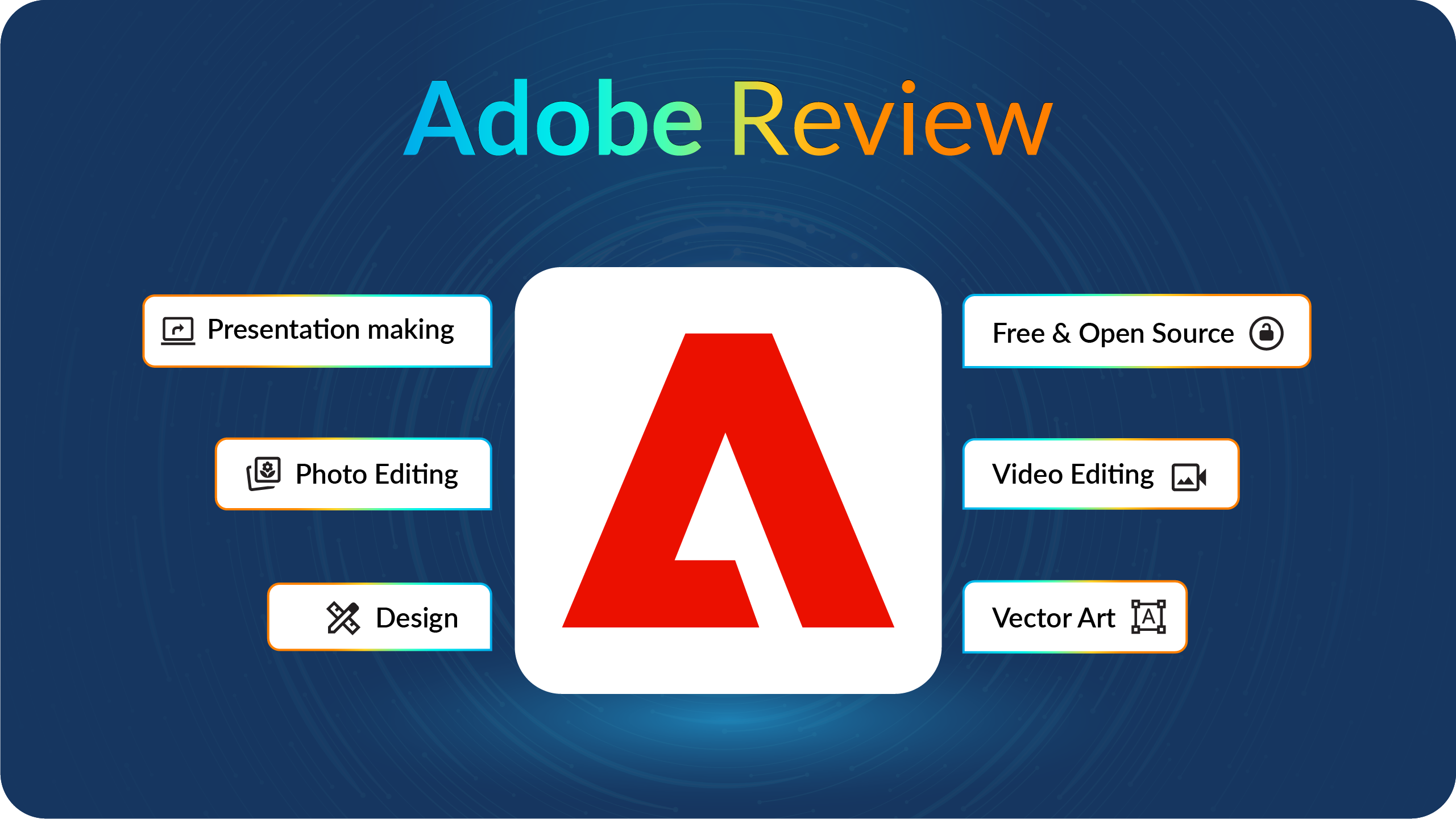
If you’re looking up an Adobe review, you’re probably trying to make sense of a much bigger ecosystem rather than a single tool. Adobe has built an entire suite of products that cover everything from image editing and illustration to video production and document design.
It’s often considered the go-to platform for creating structured, layout-heavy content like reports, brochures, and publications. But does it work well for everyday business workflows?
In this review, I’ll break down how Adobe actually performs, where it stands out, and where it starts to feel limited depending on how you plan to use it.
If you’re looking for an Adobe review, you’re not really evaluating a single tool. You’re looking at an entire ecosystem.
Adobe offers a wide range of products across design, video, documents, and marketing. Tools like Photoshop, Illustrator, Premiere Pro, and Acrobat each solve very different problems, which makes Adobe less of a product and more of a full creative stack.
That said, since we are focusing more on design capabilities, I wanted to focus this review on one specific tool within that ecosystem: Adobe InDesign.
InDesign is Adobe’s layout and publishing platform, typically used for reports, brochures, and multi-page documents where structure and consistency matter.
In this review, we’ll not just see what it can do, but how well it fits into real-world workflows where speed, clarity, and repeatability are just as important as design quality.
At Prezent AI, we spend a lot of time evaluating how different tools support real business communication workflows.
For this Adobe review, I focused specifically on how InDesign performs beyond just surface-level features.
Here’s how I tested it:
I also looked at how the platform handles practical challenges like structuring content, maintaining consistency, and the overall time required to get to a polished output.
The aim here is simple: give you a clear, experience-based perspective so you can decide whether Adobe InDesign fits the way your team actually works.
This is where Adobe InDesign really stands out.
When I started building documents, the first thing that became clear was how much control the platform gives you. You can define grids, set up margins, use master pages, and align every element with precision. Nothing feels constrained.
In practice, this means you can create highly structured, polished layouts that stay consistent across multiple pages. For things like data analysis reports or long-form documents, that level of control is genuinely valuable.
But that same flexibility also comes with a trade-off: every decision is manual.
You’re choosing how content flows, where elements sit, how spacing works, and how layouts evolve from one page to the next. There’s no system guiding you toward a “good” structure. You’re responsible for building it.
That worked well when I wanted full creative control. But it also meant that even simple layouts took time to set up properly, especially when starting from scratch.
So while InDesign gives you the tools to design exactly what you want, it doesn’t necessarily help you get there faster.
Typography is easily one of the strongest parts of Adobe InDesign.
When I started working with text-heavy layouts, this is where the platform really felt mature. You can choose fonts, character styles, spacing rules, alignment, and text flow across multiple pages with a high level of precision.
What stood out to me was how well InDesign handles consistency at scale. Once styles are set, you can apply them across an entire document and maintain uniform formatting without having to adjust each section manually.
For long-form content like reports or documents with repeated structures, this makes a big difference.
Templates were one area where the experience felt noticeably different from most modern tools.
InDesign does offer templates, but the ecosystem is not as extensive or as accessible out of the box. In most cases, you’re either starting with a blank canvas or importing external templates and adapting them.
When I tried building documents quickly, this added an extra step. Instead of picking a ready-made structure and customizing it, I had to think through the layout first and then build it.
That’s not necessarily a drawback if you’re a designer. In fact, it gives you more flexibility.
But in practical workflows where speed matters, especially when you’re working on recurring content like reports or decks, this slows things down.
On the surface, Adobe InDesign does give you the tools to maintain brand consistency.
You can define paragraph styles, color swatches, master pages, and reusable components. When everything is set up properly, it becomes easier to keep layouts visually consistent across a document.
But there are no admin-level controls to enforce this.
If someone changes a font, tweaks a color, or overrides a layout, the platform doesn’t stop you. Over time, especially across larger documents or multiple contributors, small inconsistencies can start to creep in.
This becomes more noticeable in team environments. When multiple people are working on the same file or passing versions back and forth, maintaining consistency requires constant checking.
For high-stakes design requirements, where staying on-brand isn’t an option, you might want to look at other tools like Prezent AI which maintain better brand consistency.
Collaboration is another area where InDesign feels a bit behind more modern, cloud-native tools.
Most of the workflow is still file-based.
You’re sharing files, uploading versions, or using Adobe’s cloud storage to pass documents around. While there are options to comment and review, it doesn’t feel as seamless as real-time collaboration where multiple people can work together in the same environment.
This isn’t a major issue if you’re working solo or in small design teams.
But in workflows where multiple stakeholders are involved like marketing, sales, or leadership reviews, the lack of real-time collaboration can slow things down.
InDesign works well as a design tool. It just doesn’t fully adapt to fast-moving, team-driven content workflows.
InDesign is not built with automation in mind, and it shows.
Most of the workflow is manual, from structuring content to placing elements and refining layouts. There are some advanced features like scripts and plugins, but they require additional effort and are not part of the core, everyday experience.
When I was building documents, there was very little assistance from the platform itself. No AI to help structure content, no suggestions for layout, and no support in speeding up repetitive tasks.
Everything depends on how you design it.
That works if you want full control and have the time to build things from scratch. But in workflows where speed and scale matter, this becomes a bottleneck.
This is also where platforms like Prezent AI stand out, since they actively reduce manual effort by helping with structure, content flow, and overall turnaround time.
After working through different workflows, a clear pattern started to emerge. Adobe InDesign is extremely capable, but that capability comes with trade-offs.
Adobe InDesign generally receives strong ratings across major review platforms:
To go beyond my own testing, I looked through G2 reviews to understand how InDesign performs in real-world workflows.
Most users appreciate InDesign for its precision and reliability. It’s often described as the go-to tool for creating professional, multi-page layouts, especially when consistency and structure matter. Features like master pages, typography controls, and layout tools are frequently highlighted as strengths.
At the same time, the limitations come up just as consistently.
The learning curve is one of the most common concerns. Users often mention that the interface can feel complex and takes time to get comfortable with, especially if you don’t come from a design background.
Pricing is another recurring theme. The subscription model is considered expensive, particularly for individuals or small teams who may not use the tool frequently.
There are also mentions of performance issues when working with large files, with some users describing the software as heavy or slow in more complex projects.
Overall, the user feedback aligns closely with my experience.
Adobe InDesign is available through Adobe’s subscription-based model, either as a single app or as part of the broader Creative Cloud bundle.
Here’s how the pricing typically breaks down in the US:
All plans include ongoing updates, Adobe Fonts, and cloud storage for syncing and sharing files.
If you’re evaluating Adobe InDesign specifically for business content like reports or presentations, it’s worth stepping back and asking what you actually need the tool to do.
InDesign is built for design precision. But in most business workflows, the challenge is not just designing slides or documents. It’s structuring content, maintaining consistency, and getting to a polished output quickly.
That’s where the difference between design tools and presentation platforms becomes more obvious.
Platforms like Prezent AI are built specifically for business communication.
Instead of starting from a blank canvas, you’re working with:
When I compare the two, the difference is not about which tool is “better.” It’s about what kind of work you’re trying to do.
If your priority is pixel-perfect design and full creative control, InDesign is a strong choice.
But if your goal is to create structured, on-brand presentations quickly, especially at scale, a dedicated platform like Prezent AI fits that workflow much more naturally.
Adobe is one of the most powerful tools available for layout design and publishing. When it comes to precision, typography, and multi-page document control, it’s hard to match what InDesign can do.
But after working through different workflows, one thing became clear to me.
InDesign is built for designers. It gives you complete control, but it also expects you to handle everything yourself, from structuring content to refining layouts and maintaining consistency. That works well for publishing use cases where quality and control matter more than speed.
In business environments, though, the requirements are slightly different.
You’re often working with tight timelines, multiple stakeholders, and the need to create clear, structured communication quickly. In those scenarios, the manual nature of InDesign can start to slow things down.
That’s where purpose-built platforms like Prezent AI feel more aligned. They reduce the effort behind structuring content, maintaining brand consistency, and producing polished outputs at scale.
So the decision comes down to this: If your work revolves around detailed design and publishing, InDesign is a strong investment.
If your focus is faster, repeatable, and business-driven content creation, you may find more value in tools like Prezent AI.
Book a demo or start a free trial to see if Prezent AI is a better fit for your workflow.
Adobe is a software company that offers a wide range of tools for design, video editing, document management, and digital marketing. Its ecosystem includes products like Photoshop, Illustrator, Premiere Pro, Acrobat, and InDesign, each built for different creative and business use cases.
Rather than being a single tool, Adobe functions as a complete creative suite that supports everything from visual design to content production and publishing.
Adobe InDesign is primarily used for creating structured, multi-page documents such as reports, brochures, magazines, ebooks, and other publishing materials where layout and formatting consistency matter.
InDesign works well for business use cases that involve detailed design and document publishing. However, for faster workflows like presentations or recurring business content, it can feel time-intensive due to its manual nature.
InDesign is not the most beginner-friendly tool. It has a learning curve, especially if you are not familiar with design concepts like grids, typography, and layout systems.
Microsoft PowerPoint is better suited for presentations, while InDesign is built for static documents. You can create presentation-style layouts in InDesign, but it is not optimized for presenting, editing quickly, or collaborating with teams.
The best alternative depends on your use case. For design-heavy documents, tools like Illustrator or Canva can work. For business presentations and structured communication, platforms like Prezent AI are often a better fit since they focus on speed, storytelling, and brand consistency.

Niyati is a Content Marketing Specialist with over 5 years of experience creating product-led content that drives conversions. She focuses on building high-intent, search-driven content that aligns closely with product value and turns traffic into users. Having worked with several SaaS and AI-first companies, she specializes in bridging content strategy with measurable growth.
Connect with her on LinkedIn.