No items found.
No items found.
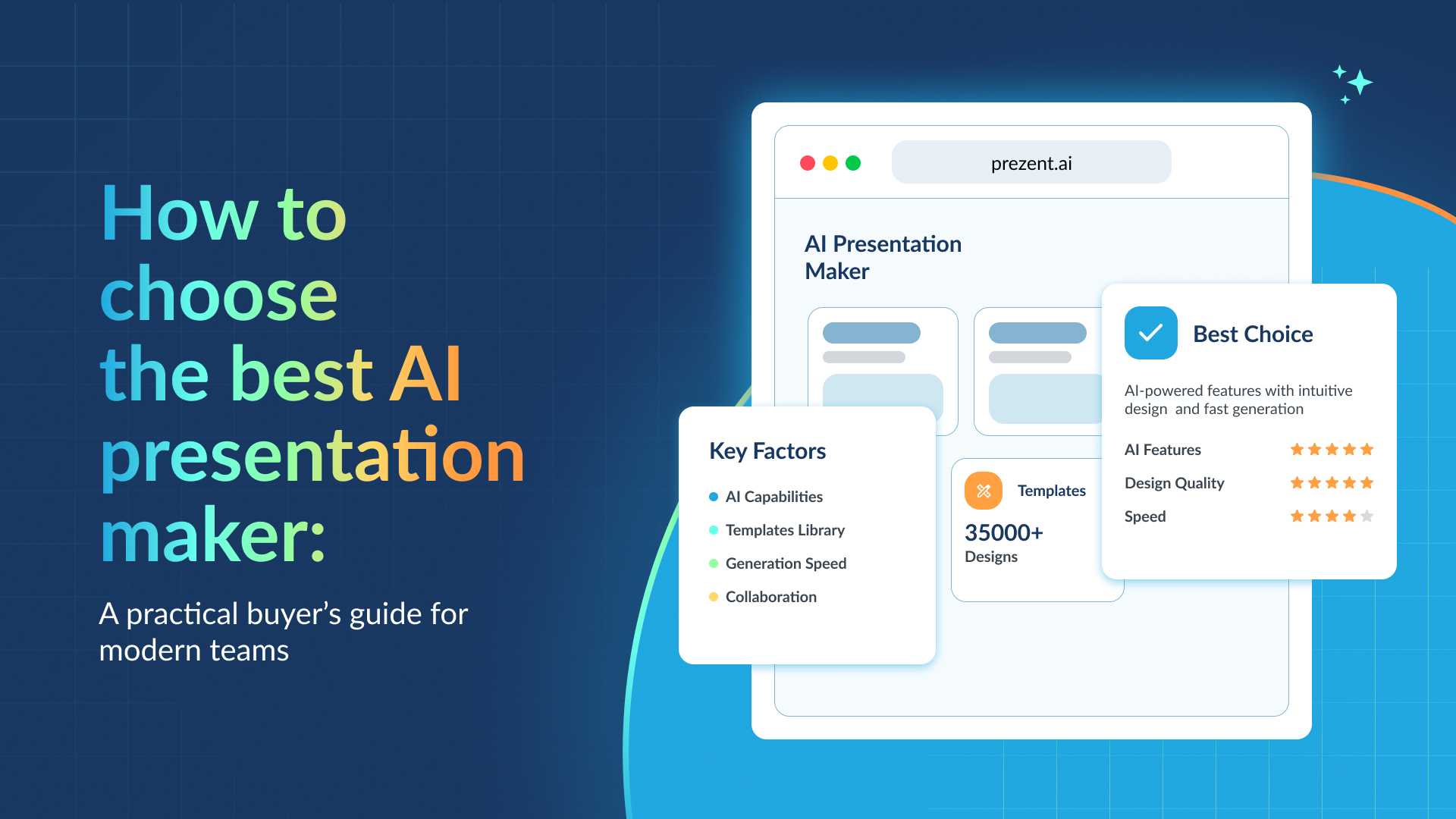
I have seen too many teams choose presentation software based on a polished demo, only to struggle with it six months later. The slides look impressive during the sales pitch. But once the tool hits real workflows, cracks appear. Templates get duplicated, messaging drifts, and teams spend more time fixing slides than building ideas.
Choosing an AI presentation maker in 2026 is not about speed alone. It is about finding a platform that understands how your company communicates, protects your brand, and supports collaboration at scale.
Here is how I recommend evaluating your options.
Use this table during vendor demos or pilots to stay objective.
Before comparing products, define how your teams actually use presentations. Different departments have different goals and communication styles:
Each use case demands a unique tone, structure, and data emphasis. A generic slide generator cannot meet all those needs equally well.
Why it matters: Choosing a tool without understanding internal workflows often leads to poor adoption. When you know who creates presentations, how content flows for review, and where delays occur, you can target the right friction points, whether that is version control, content reuse, or brand compliance.
Action step: Map your content lifecycle before shortlisting vendors. Ask:
When your technology aligns with real workflows, it accelerates output and eliminates redundancy.
By now, turning a prompt into slides is common. The true differentiator is context understanding. Can the AI grasp business intent, adapt tone, and recommend meaningful structure?
Look for AI that can:
Why it matters: Surface-level tools create content that looks polished but often sounds generic. Business communication works when tone, structure, and message match the audience and setting.
When I evaluate vendors, I ask direct questions:
This is where platforms like Prezent stand out. Instead of treating AI as a design shortcut, Prezent focuses on narrative intelligence and personalization. The outcome is structured, purpose-driven communication aligned to the audience.
Check how enterprise teams are generating on-brand AI-powered decks upto 90% faster with Prezent.
Brand inconsistency is one of the most expensive hidden costs in large organizations.
I have seen teams spend hours fixing outdated logos, incorrect fonts, or off-brand colors before executive meetings. That time adds up.
When evaluating a platform, check for:
Why it matters: When brand consistency is automated, everyone saves time. Review cycles shorten, marketing maintains oversight, and key stakeholders spend less time policing visual details and more time improving strategy.
Prezent approaches brand governance with this balance in mind. Teams get flexibility within approved boundaries, which protects consistency without limiting creativity.
A library of 500 static templates sounds impressive. In practice, most of them sit unused.
What matters is whether templates adapt intelligently to the content type and purpose.
I evaluate whether templates can:
Why it matters: Intelligent templates shorten the path from idea to-ready deck. They eliminate formatting headaches, helping presenters focus on message clarity instead of slide adjustments.
Quick test: Build three decks, a sales pitch, an executive quarterly review, and a new product training session. If they look nearly identical, the system lacks depth.
Prezent’s use-case-driven templates adjust layouts, visuals, and story structure based on intent. Users can refine node count, slide count, layout, and visuals without being locked into a rigid output. The first draft often feels 80% meeting-ready.
Even the most advanced platform fails if it disrupts existing habits. AI presentation software should connect effortlessly with the tools your organization already uses.
Check for integration with:
Ask vendors:
Why it matters: Smooth workflow integration prevents teams from jumping between apps, reduces manual upload/download cycles, and keeps teams productive in tools they already trust.
Prezent’s API integrates with major enterprise ecosystems, helping teams improve output without changing their workflow.
Presentations often include financial projections, customer data, and product roadmaps. . Your platform must meet enterprise-grade standards.
Verify the following:
Why it matters: Weak data governance puts sensitive content at risk and exposes organizations to legal and reputational harm. Always confirm where data is stored, who can access it, and whether your content contributes to external AI training.
Prezent treats enterprise security as a built-in standard, which is critical for regulated sectors such as finance, healthcare, and technology.
True personalization means more than swapping names or adding logos. It’s about crafting messages that resonate with specific audiences and contexts.
A strong AI engine should help tailor:
Why it matters: Generic decks lose attention quickly. Personalized storytelling, backed by relevant data, drives retention and credibility.
Prezent’s AI, Astrid, incorporates industry-trained language models that adapt tone, terminology, visuals, and story flow, producing personalized decks that remain brand-compliant and audience-appropriate.
Read more about Astrid here to see how it makes hyper-personalization seamless.
Speed is meaningless if your output lacks depth or coherence. Many AI tools generate slides quickly but require heavy rewriting.
When evaluating tools, use real project briefs from your business rather than demo prompts. Then assess:
Why it matters: AI should reduce cognitive effort, not shift it. A strong platform will improve storytelling flow, tighten structure, and minimize manual refinements.
Prezent emphasizes structured narrative frameworks, helping teams refine ideas rather than rebuild content.
Low pricing does not always equal strong value. Scalability and support matter more over time. Many teams start with low-cost tools that later create hidden expenses through limited seats, missing features, or poor governance.
Evaluate carefully:
Test scalability early:
Also, check the vendor’s commercial flexibility, whether they offer volume-based pricing, predictable renewals, or included support tiers. A platform that scales gracefully saves far more time and cost in the long term.
Prezent’s architecture supports enterprise-wide expansion while maintaining governance and performance consistency, making it ideal for growing organizations.
You’re not just buying today’s AI capability; you’re investing in a vendor’s strategic direction. A clear roadmap reveals whether the platform will continue evolving with your business communication needs.
Ask vendors:
A transparent roadmap and active feedback loop signal maturity. Vendors that communicate openly and iterate consistently are more likely to grow with you.
Prezent’s roadmap emphasizes deeper personalization, stronger narrative intelligence, and enterprise readiness, thereby aligning perfectly with AI-driven communication.
Before committing company-wide, launch a short pilot program. Real-world testing always reveals what demos can’t.
Involve diverse teams such as:
Measure tangible outcomes:
Why it matters- A pilot helps you uncover both strengths and friction points, from integration issues to governance gaps, before you invest fully. The feedback from these early users becomes your proof of value when presenting the case internally.
Vendors like Prezent often support guided pilots, helping teams measure success benchmarks such as time savings and content consistency clearly.
Even the smartest AI platform fails without strong support. Assess:
Reliable support ensures smoother adoption, especially during enterprise-wide transitions.
Prezent backs enterprise clients with proactive onboarding and responsive assistance. In addition to standard support, Prezent offers expert services, including overnight presentation assistance, delivering on-brand, curated decks within 24 hours, and expert-led communication workshops and other hands-on support to help teams strengthen how they present.
Many organizations fall into predictable traps when selecting AI presentation software:
Avoid these pitfalls, and you’ll select a tool that supports communication across every layer of your organization.
If you would like a broader market view, explore our detailed comparison of 14 popular AI-powered presentation makers to see how different platforms stack up across features, governance, and scalability.
Choosing an AI presentation maker in 2026 is a strategic investment in how your organization communicates. The right platform should:
From what I’ve seen, platforms combining narrative intelligence, personalization, governance, and enterprise security deliver lasting impact. That is why solutions like Prezent are gaining attention among modern enterprises.
If you’re exploring AI presentation platforms, take a pilot-driven approach. Load your real decks, test workflows, and see how the tool performs under real pressure.
Explore how Prezent fits into your team’s workflow, and schedule a personalized demo.
We’ll walk through your real use cases and show you how a clearer structure, stronger brand control, and audience-ready storytelling can come together in one platform.
Free AI presentation tools from Canva, Beautiful.ai, or Plus AI typically offer a free plan available with limited AI features. You may get basic slide creation, 3 free presentations, or simple AI-generated content from a prompt. These free tiers are helpful for quick social media content or lightweight decks.
Enterprise AI presentation makers go further. They offer unlimited AI, advanced AI features, brand governance, advanced design controls, and integrations with Google Workspace or Microsoft 365. Tools like Prezent are built for professional presentations that require compliance, customization, and scalability across teams.
If you need more than basic presentation creation, enterprise platforms provide stronger controls and long-term flexibility.
Yes. The best AI presentation makers export seamlessly to Google Slides and PowerPoint, along with a PDF for sharing externally.
Enterprise-grade tools maintain brand consistency and advanced design during export, so your generated presentation remains polished across platforms. This ensures your full presentation can move between systems without manual reformatting.
If your workflow depends on Google Slides or PowerPoint for final edits, make sure export quality is tested during your trial.
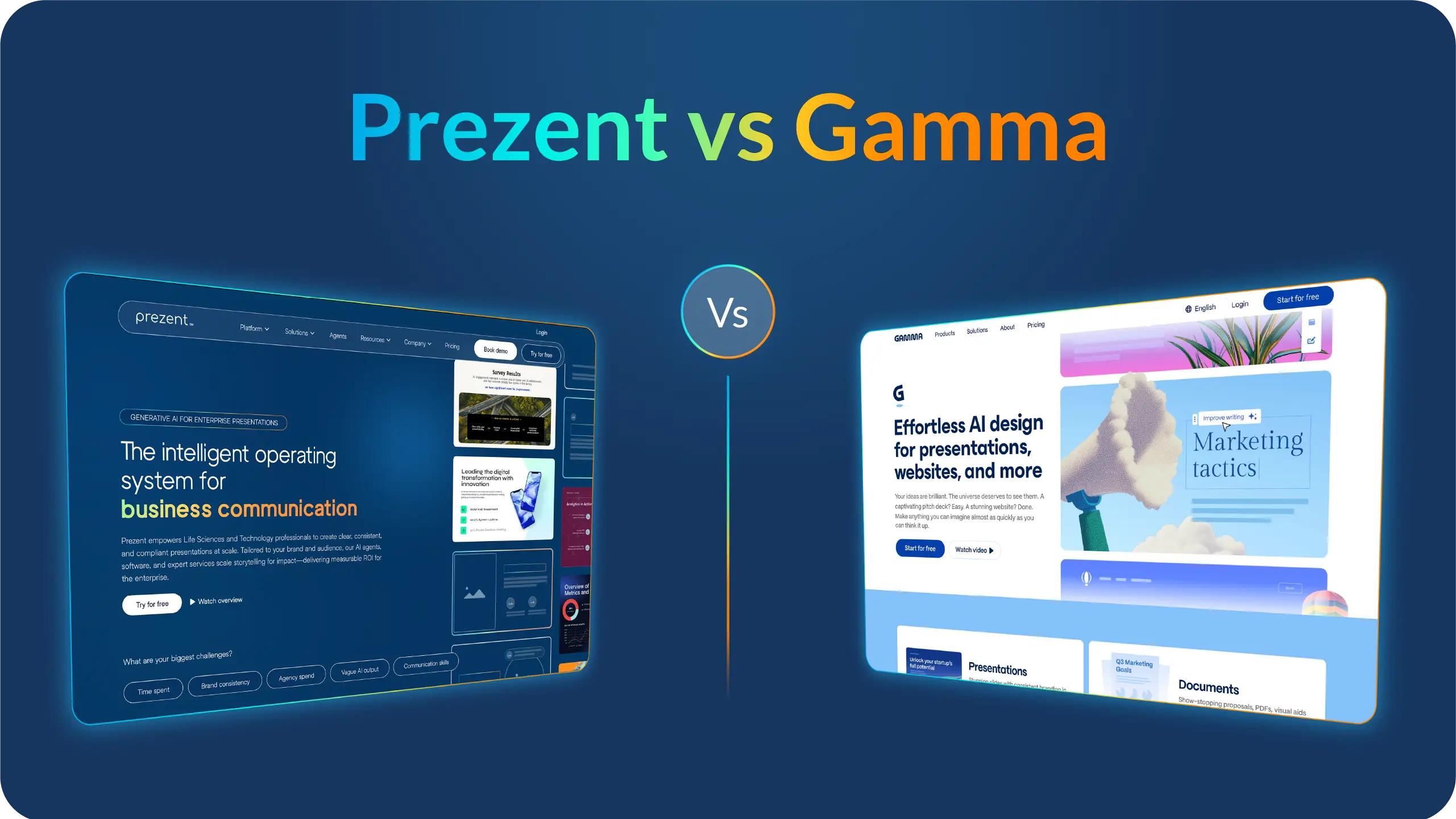
Prezi AI and Gamma AI are strong in presentation aesthetics and AI-generated slide decks from a simple prompt. Canva AI offers built-in AI image tools and features like Canva Magic Design for quick visuals. Microsoft Copilot in PowerPoint provides AI assistance directly inside Microsoft 365.
Prezent differentiates itself with enterprise governance, audience-level personalization, and workflow integration across teams. While consumer-focused presentation tools on the market prioritize speed and design, Prezent focuses on business communication, compliance, and structured storytelling.
If you want AI assistance without sacrificing governance or control, the distinction becomes clear.
Yes, especially enterprise platforms.
Top AI presentation generators include centralized brand libraries, locked presentation templates, and compliance controls. You can upload your own images, customize layouts, and ensure every professional presentation aligns with brand standards.
This eliminates “rogue slides” across sales, marketing, and executive teams. Instead of traditional slides being built manually, AI-powered presentation systems embed brand rules directly into presentation design.
Most platforms offer either a 7-day free trial or a free tier with limited AI functionality. Free plans usually include basic slide creation from an AI prompt and access to a small set of presentation templates.
Paid tiers such as Canva Pro unlock advanced features, unlimited AI usage, export flexibility, and broader customization options. Enterprise tiers add governance, security, Google Workspace or Microsoft 365 integration, and administrative controls that free and paid consumer plans cannot match.
When comparing tools, review what “limited AI” actually means in practice.
AI presentation makers are designed to complement Google Slides or PowerPoint, not fully replace them.
They accelerate presentation creation by generating slide decks from prompts, helping teams skip the blank slide stage. Many integrate directly with Microsoft 365 workflows or export cleanly for final edits in familiar tools.
The right AI presentation tool can significantly speed up slide decks while maintaining compatibility with Google Slides and PowerPoint for finishing touches.
Start with your use cases. A sales pitch differs from a board deck or internal training module. Identify how your teams use presentations and where friction occurs.
Then evaluate AI features such as personalization, brand governance, advanced design controls, integrations with Google Workspace or Microsoft 365, and export flexibility.
Test the platform with real content during a 7-day free trial or “try it free” period. Measure how well it handles presentation creation, supports collaboration, and scales across departments.
Consumer tools like Canva or Prezi may work for lighter use. Enterprise teams often need more structure, advanced AI, and governance. Platforms like Prezent are built specifically to support business-grade presentation workflows at scale.
.webp)
Supriya is a Content Strategist and Creator at Prezent AI with extensive experience in brand storytelling, digital strategy, and B2B content. She has worked across SaaS and technology-driven businesses, building content engines that drive awareness, engagement, and pipeline growth. Passionate about crafting clear, insight-led narratives, Supriya focuses on turning complex ideas into compelling stories that resonate with modern business audiences. You can connect with her on LinkedIn.
.png)