Assertive communication is widely regarded as the most effective communication style because it is clear, direct, concise, and, most importantly, respectful. While it's rare for anyone to always use only one communication style, individuals who consistently practice assertiveness are considered assertive communicators.
In this article, we will explore why assertive communication is so impactful, compare it with other styles through practical examples, and offer tips to help you develop and enhance your assertive communication skills.
Understanding assertive communication:
Assertive communication is often confused with formal business communication. However, assertive communication is actually a form of communication in which the communicator clearly expresses their needs or feelings without being aggressive or withholding their emotions. Assertive communicators respectfully convey their opinions, views, and feelings.
Assertive communicators display several key characteristics that are important to recognize and develop. These include:
Clarity: Assertive communicators clearly state their thoughts and feelings without confusion or hesitation. They are direct in expressing what they need or want.
Respectfulness: They respect the rights, opinions, and feelings of others. This respect extends to their communication and listening to others.
Confidence: Assertive communicators are confident in expressing their opinions and needs.
Responsibility: They take responsibility for their own actions and words rather than blaming others or making excuses.
Calmness: Assertive communicators often maintain a calm and composed disposition, even in stressful or challenging situations. They manage their emotions and do not resort to aggression.
Use of "I" statements: They often use "I" statements to express their feelings and needs. This helps them take ownership of their emotions without blaming others.
Listening skills: Assertive communicators are good listeners. They pay attention to what others say and respond thoughtfully rather than interrupting or dismissing them.
Why is the assertive communication style considered best?
The assertive style stands out as the most effective and productive. This style allows individuals to express their thoughts and needs clearly and respectfully, promoting better relationships and outcomes.
Job satisfaction and career advancement: Employees who use an assertive style are more likely to experience job satisfaction and career advancement. Studies conducted with professional nurses found that assertive communication positively affects job satisfaction levels. Nurses who communicate assertively can better advocate for their needs and collaborate with colleagues, leading to a more fulfilling work environment.
Self-esteem and confidence: People who practice assertiveness feel more in control of their lives and are better able to advocate for themselves, which enhances their overall well-being. A research paper investigating the impact of assertiveness training on high-school students found that such training significantly increased assertiveness while decreasing aggression and submission among the students. This demonstrates that the assertive style of communication develops a sense of empowerment and confidence, which is crucial for personal and professional growth.
Reduced stress and anxiety: The medical and health industry emphasizes assertive communication due to its significant impact on reducing stress and anxiety levels. Studies suggest that by expressing themselves clearly and standing up for their rights, assertive individuals experience fewer misunderstandings and conflicts. Assertive communication helps create a more supportive and less stressful environment, which is crucial for maintaining optimal mental and emotional health.
How can aggressive communicators develop assertive communication skills?
Aggressive communicators are primarily focused on achieving their goals and agendas, often disregarding the needs of others, positions, or situations. Their approach can be overly forceful and demanding, which may lead to negative consequences and strained relationships. This communication style tends to isolate others and creates a hostile environment, ultimately undermining long-term collaboration and trust.
Aggressive communicators are often straightforward in expressing their demands, but the way they communicate can come across as disrespectful and lacking empathy. In contrast, assertive communicators express their needs and opinions clearly and respectfully, balancing their needs with consideration for others.
Examples of assertive vs aggressive communication:
Let's see the difference between these communication styles with a few examples:
Situation
Aggressive Communication
Assertive Communication
Team meeting disagreement
Your idea will never work.
We should do it my way, and that's final.
You clearly don't understand what needs to be done.
I see your point, but I have some concerns about the approach.
I think we should consider an alternative method that aligns better with our objectives.
Can we explore that option together?
Missed deadline by a colleague
This is completely unacceptable.
You've failed to deliver on time, and now everything is ruined.
You need to get your act together!
I noticed that the report wasn't submitted by the deadline.
This impacts our schedule, and I need to understand what happened.
Let's work on a plan to ensure we meet future deadlines.
Requesting a plan change
I can't believe you chose that date without asking me.
You need to change it right now.
I just realized that I have a conflict on the date we planned for the event.
Could we consider rescheduling?
Key differences:
Focus: Aggressive communicators prioritize their own needs, often at the expense of others. Assertive communicators aim for a balance, expressing their needs while respecting others.
Tone: Aggressive communication is often harsh and confrontational. Assertive communication is respectful and composed.
Outcomes: Aggressive communication can lead to conflict and damaged relationships. Assertive communication fosters understanding, collaboration, and positive relationships.
Developing assertive skills can transform the way aggressive communicators interact with others, fostering healthier and more productive relationships. Here are several strategies to help aggressive communicators become more assertive:
Understand your triggers: Improve your ability to manage emotions by identifying what makes you angry and triggers aggressive behavior. Once you understand your triggers, you can work on managing or controlling them. Some of the useful cooling strategies that you can use are:
Take a pause and practice deep breathing.
Disengage and walk away from the situation temporarily.
Visualize a calm space or happy thoughts.
Smile to help reverse feelings of rage.
Self-assessment: Understand your preferred communication type and style. Communication assessments can provide insights into your strengths, communication style, and offer strategies for improving interactions with others. These assessments can reveal whether you are a direct or indirect communicator, an extrovert or introvert, and whether you are detail-oriented or people-oriented.
Consider a mentor or coach: A mentor or coach can provide valuable direction and feedback. They can help you refine your communication and improve your performance over time. Ask for feedback from your team or colleagues, or observe how others respond when you communicate. However, having a mentor or paid coach is often more effective, as people may be reluctant to provide honest feedback.
Pay attention to your body language and gestures: Assertive individuals maintain a relaxed posture and appear engaged. Even when emphasizing a point, their body language remains firm and appropriate without becoming defensive. Here are a few strategies that you can use:
Make eye contact when talking, but avoid staring.
Keep an open stance and avoid crossing arms.
Avoid pointing or jabbing.
Lean slightly forward to show engagement.
Be self-aware and present in the moment to control your body language.
Stay attentive and practice active listening: Active listening is crucial for effective communication and leadership. Allow team members to speak and stay attentive when they are talking. As you grow in authority, becoming a better listener helps you understand others' perspectives, develop your ideas, and make your team members feel heard and valued.
Understand others: Understanding others' styles is crucial for building strong relationships and responding appropriately. By identifying whether someone is an introvert or extrovert, a direct or indirect communicator, or if they prefer detailed discussions or casual conversations before getting down to business, you can adapt your approach to connect more effectively. This method of adapting to someone else's style is called "flexing your communication style."
Here are a few tips to help you to flex your communication style:
Identify the communication preferences of the person you are conversing with.
Adjust your communication to align with their preferences. For example, if someone is detail-oriented, provide thorough information. If they are more casual, engage in small talk before discussing business matters.
Show genuine interest in their communication style and be prepared to switch between styles as needed. This flexibility ensures that you can effectively engage with diverse personalities and preferences.
How can passive communicators develop assertiveness?
Passive communicators exhibit traits opposite to those seen in aggressive communicators. They often sideline their own needs, wants, and goals in favor of accommodating others. By not voicing their opinions, they may experience frustration and dissatisfaction, which can contribute to feelings of depression. This tendency to prioritize others over themselves and a lack of self-expression can lead to a diminished sense of self-worth and emotional well-being.
Examples of assertive vs passive communication:
Understanding the difference between passive and assertive communicators can help you develop more effective interactions. Here are a few examples to explain these two styles:
Situation
Passive Communication
Assertive Communication
Handling feedback
I understand that my work might not be up to standard, but I guess that's just how it is.
I’ll try to do better next time.
Thank you for the feedback.
I see the areas where I can improve.
Can we discuss ways I can improve my performance moving forward?
Making a request
I don’t want to bother you, but if you have time, could you help me with this?
I understand if you’re too busy.
I need assistance with this task.
Could you help me with it by the end of the week? Your support would be greatly appreciated.
Expressing disagreement
I suppose I could agree with your point, even though I don’t really see it the same way.
It’s probably not worth arguing about.
I have a different perspective on this issue.
Can we discuss it further? I believe exploring both viewpoints could help us find the best solution.
Key differences:
Directness: Assertive communicators address issues directly and clearly, whereas passive communicators often avoid confrontation and downplay their needs.
Self-expression: Assertive communicators express their thoughts and feelings openly, while passive communicators tend to suppress their opinions and desires.
Respect and engagement: Assertive communicators balance respect for themselves with respect for others, engaging actively in conversations. Passive communicators may prioritize others' needs to the detriment of their own, leading to less effective communication.
If you have a passive style and often take a backseat when it comes to sharing your ideas and opinions, you possess a valuable strength: being a good listener. You can leverage this strength to develop better solutions and strategies in your meetings.
Here are a few points that can help you develop an assertive response:
Focus on active listening: Use your listening skills to understand different perspectives and gather information. This can help you form well-rounded, informed responses and contribute meaningfully to discussions.
Plan ahead: Prepare for upcoming meetings by outlining key points you want to discuss. Practice how you will present your ideas and anticipate possible questions or objections.
Avoid being apologetic: Express your thoughts and opinions without unnecessary apologies or disclaimers. Be direct and clear about your contributions.
Choose a positive tone and body language: Use a confident, positive tone when speaking. Maintain an open posture, make eye contact, and avoid fidgeting to convey self-assurance.
Be confident: Believe in the value of your contributions. Remind yourself that your ideas and opinions are important and worth sharing.
How can passive-aggressive communicators communicate better?
Passive-aggressive communicators avoid directly expressing their negative feelings or frustrations. Instead, they convey these emotions indirectly, which often results in unproductive and negative interactions. This communication style combines the detrimental effects of both aggressive and passive approaches. On one hand, passive-aggressive communicators struggle to express their true feelings, leading to internal frustration. On the other hand, their indirect methods can undermine relationships by appearing hostile and creating misunderstandings. This dual impact can erode trust and hinder effective communication.
Examples of assertive vs passive-aggressive communication:
Let us understand the difference between passive-aggressive communication style and assertive style with a few examples:
Situation
Passive-aggressive Communication
Assertive Communication
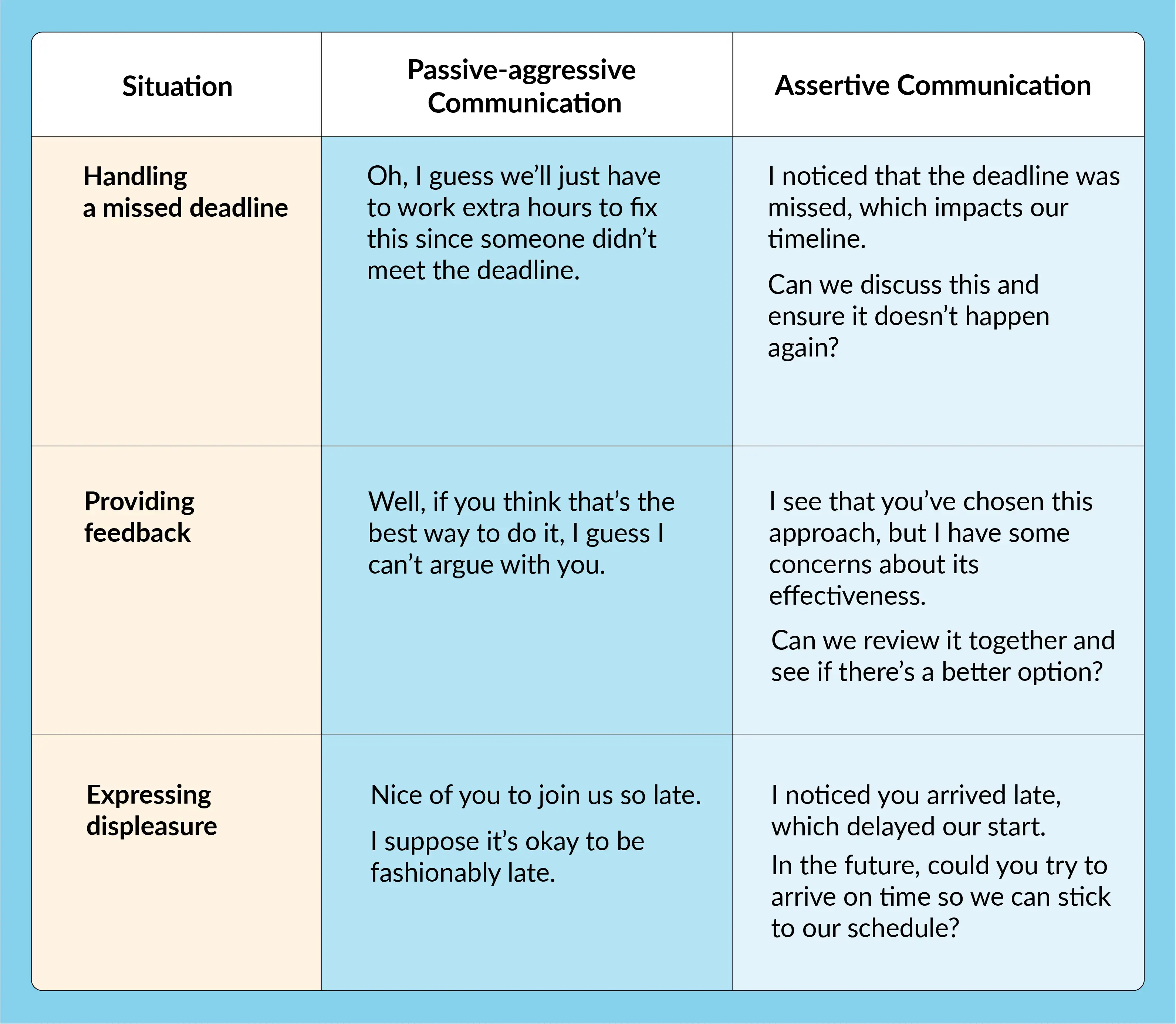
Handling a missed deadline
Oh, I guess we’ll just have to work extra hours to fix this since someone didn’t meet the deadline.
I noticed that the deadline was missed, which impacts our timeline.
Can we discuss this and ensure it doesn’t happen again?
Providing feedback
Well, if you think that’s the best way to do it, I guess I can’t argue with you.
I see that you’ve chosen this approach, but I have some concerns about its effectiveness.
Can we review it together and see if there’s a better option?
Expressing displeasure
Nice of you to join us so late.
I suppose it’s okay to be fashionably late.
I noticed you arrived late, which delayed our start.
In the future, could you try to arrive on time so we can stick to our schedule?
Key differences:
Directness: Assertive communicators address issues directly and constructively, while passive-aggressive communicators express dissatisfaction indirectly, often through sarcasm or subtle criticism.
Clarity: Assertive communication is clear and straightforward, making intentions and feelings explicit. Passive-aggressive communication is ambiguous and often leaves others guessing about the underlying issues.
Impact on relationships: Assertive communication fosters open and respectful dialogue, enhancing relationships. Passive-aggressive communication, due to its indirect nature and underlying negativity, can create confusion, mistrust, and strained relationships.
If you have a passive-aggressive communication style, you might be expressing frustration indirectly, as shown in the examples. However, you also possess valuable strengths: the clarity of aggressive communicators and the listening skills of passive communicators. By harnessing these strengths and employing a few key strategies, you can develop assertive skills, leading to more effective and positive interactions. Self-awareness and practical techniques will help you transition to a more direct and respectful communication style.
Here’s how you can make that transition:
Recognize passive-aggressive behaviors: Understand how passive-aggressive tendencies manifest, such as sarcasm, procrastination, or indirect criticism. Acknowledging these patterns is the first step toward change.
Practice direct communication: Express your thoughts and feelings openly and honestly. For instance, instead of sarcasm, state your concerns directly: "I feel frustrated when deadlines are missed. Can we discuss how to address this?"
Seek constructive solutions: Approach conflicts with the aim of finding solutions rather than indirectly expressing dissatisfaction. Propose actionable steps and work collaboratively to resolve issues.
Develop empathy: Try to understand others’ perspectives and needs. This can help you communicate in a way that acknowledges both your own feelings and those of others.
Adopt positive body language: Use open and confident body language, such as maintaining eye contact, keeping a relaxed posture, and avoiding defensive gestures. This can reinforce your assertive communication.
Develop assertive communication skills with Prezent:
Prezent can help you enhance your communication skills and effectiveness in several ways:
Prezent’s fingerprint feature: This tool provides valuable insights into your audience's presentation style, data preferences, and more, allowing you to tailor your communication to their needs effectively.
Bite-sized online courses: Prezent offers thoughtfully curated, engaging, and interactive courses. These courses feature short videos and assessments designed to improve your communication skills incrementally.
Zenith learning workshop: Gain industry-leading guidance on business communication from experts. These workshops provide practical tips and strategies to help you and your team communicate more assertively and effectively.
By leveraging Prezent's tools and resources, you can develop an assertive style of communication that enhances your ability to engage with your audience and convey your ideas with confidence.
Learn more about Prezent and how you can refine your business communication and presentations. Explore the platform yourself with a free trial or schedule a demo with our experts to understand all the available features and powerful tools.
15 AI Reporting Tools I Tested for Faster, Clearer Reporting
Explore AI reporting tools that automate data analysis, dashboards, and reporting. Compare platforms that help teams turn data into clear insights faster.
Explore the best presentation design services. Compare agencies that help teams create polished slides, improve storytelling, and design clearer presentations.
Claude for PowerPoint: How it works, setup, limitations, and enterprise solutions
Claude for PowerPoint guide: learn step-by-step setup, AI presentation creation, workflow best practices, and the limitations enterprise teams should consider.
How to choose the best AI presentation maker: A practical buyer’s guide for modern teams
Find the best AI presentation maker for your team. Learn how to compare AI presentation generators, templates, brand control, and integrations before choosing the right tool.
What is an AI presentation maker? Capabilities, limitations & use cases
Cut deck time by 80% with AI presentation makers. This enterprise guide covers must-have features, proven ROI, and a PowerPoint comparison, plus real-world use cases for proposals, QBRs, and RFPs.
Best Canva alternatives: AI presentation tools from free to enterprise
Looking for a Canva alternative for presentations? Compare AI tools, free and paid plans, workflows, and features across small business and enterprise platforms.
7 Best Google Slides alternatives: Best presentation software for business teams
Google Slides alternatives ranked for business. Compare AI presentation tools, enterprise features, pricing, and collaboration options to find the right fit for your team.
14 Best Visme alternatives: Free, AI-powered, and enterprise presentation tools compared
14 Best Visme alternatives: Compare 14 AI presentation platforms like Prezent, Canva, and Piktochart by pricing, templates, storytelling, and content creation features.












.png)