No items found.
No items found.

Workplace communication is inherently complex, given the variety of personalities and communication styles and the necessity to maintain a professional demeanor. It becomes particularly challenging when interacting with individuals who do not express their negative feelings openly. Instead, they display these feelings indirectly through actions such as delayed responses, missed deadlines, sarcasm, or negative tones in both verbal and written communication. These individuals are often categorized as passive-aggressive communicators.
In this article, we will explore passive-aggressive communication and examine how it can impact workplace relationships. We will discuss effective strategies for responding to passive-aggressive communicators, improving communication skills if you exhibit passive-aggressive tendencies, and, most importantly, identifying passive-aggressive behavior in both verbal and written forms, with illustrative examples.
Passive-aggressive communication is when individuals express their negative thoughts and feelings or resentment indirectly rather than directly addressing the issue. This behavior can be seen in various ways, such as sarcasm, procrastination, backhanded compliments, or even silence. The main characteristic of this style of communication is a disconnect between what is being said and what is truly felt.
Individuals and organizations can foster healthy relationships and a more productive environment by understanding passive-aggressive communication, identifying its signs, and learning how to address and improve it.
Although this communication style often involves subtle and indirect behaviors, identifying it is crucial. Below are some common signs of a passive-aggressive person:
Sarcasm: Passing subtly sarcastic remarks that are intended to hurt or undermine another person.
Example:
· Oh, you're so smart. I would have never thought of that.
· Great, another brilliant idea.
Procrastination: Delaying tasks intentionally as a way to resist demands.
Example:
· I’ll get to it when I can.
· I didn't realize it was so urgent.
Silent treatment: Ignoring or refusing to speak to someone to express displeasure or avoid confrontation.
Backhanded compliments: Giving compliments that have an underlying negative or insulting tone.
Example:
· You look good today, for a change.
· This report is surprisingly good.
Chronic lateness/ Pretending ignorance: Consistently being late as a form of passive resistance.
Example:
· Oh, I didn't know that was important.
· You never told me it had to be done today.
Sullen behavior: Displaying a sullen or resentful attitude without openly discussing the issue.
Example:
· Whatever you say.
· Sure, if that's what you want.
Playing the victim: Often displaying or pretending to be the victim in conflicting situations.
Example:
· I guess it’s always my fault.
· No one ever listens to me anyway.
Blaming others indirectly: Pushing the blame indirectly on others without accepting the fault and showing intention to not repeat the mistake in the future.
Example:
· I would have done it, but no one reminded me.
· It’s hard to get anything done when everyone else slacks off.
Non-committal responses: Giving vague and non-committal replies that do not exhibit clarity or commitment.
Example:
· I'll think about it.
· We'll see.
Passive aggression can be easier to spot in verbal communication, but it often goes unnoticed or misunderstood in written communication. Even when we sense negativity in writing, we might doubt ourselves and ignore it. However, if left unaddressed, passive-aggressive communication can negatively impact work and team dynamics.
Here are some examples to help identify passive-aggressive communication in written form:
Emails with sarcasm:
· Thanks for your timely response (sent after waiting too long for a reply).
· I appreciate your 'hard work' on this project.
Vague statements:
· Per our conversation, you know what I mean.
· As discussed.
Intentional missed details:
· Attached is the document you wanted (leaving out key information).
· Here is the report (without attaching it).
Emails highlighting resentment:
· I hope you're happy with the results.
· I guess I’ll just have to handle this myself, again.
Pretending innocence:
· I was under the impression that someone else was handling this.
· I didn’t realize this needed immediate attention.
Backhanded praise in reports or feedback:
· This is better than your last attempt.
· Considering your experience, this is quite good.
Deliberate delay in response:
· Sorry for the delay, I was just swamped with more urgent tasks.
· I just saw this; I'll get to it when I can.
Emails indicating reluctance:
· I’ll try to squeeze this in between my other duties.
· I’ll see if I can find time to look into this.
Not everyone who exhibits passive-aggressive behavior will consistently show all the signs. Many people might display passive-aggressive tendencies occasionally, especially when they feel powerless, stressed, or unable to express their emotions directly. It’s essential to understand that passive-aggressive communication exists on a range, and while some individuals may consistently communicate this way, others might do so occasionally.
Negative communication patterns impact a person’s workplace life in similar ways as how they can impact someone's personal life. Passive aggressive behavior can manifest several detrimental effects on the workplace, including:
Dealing with passive-aggressive communicators requires a strategic and empathetic approach. You must ensure that you don’t respond aggressively at your workplace.
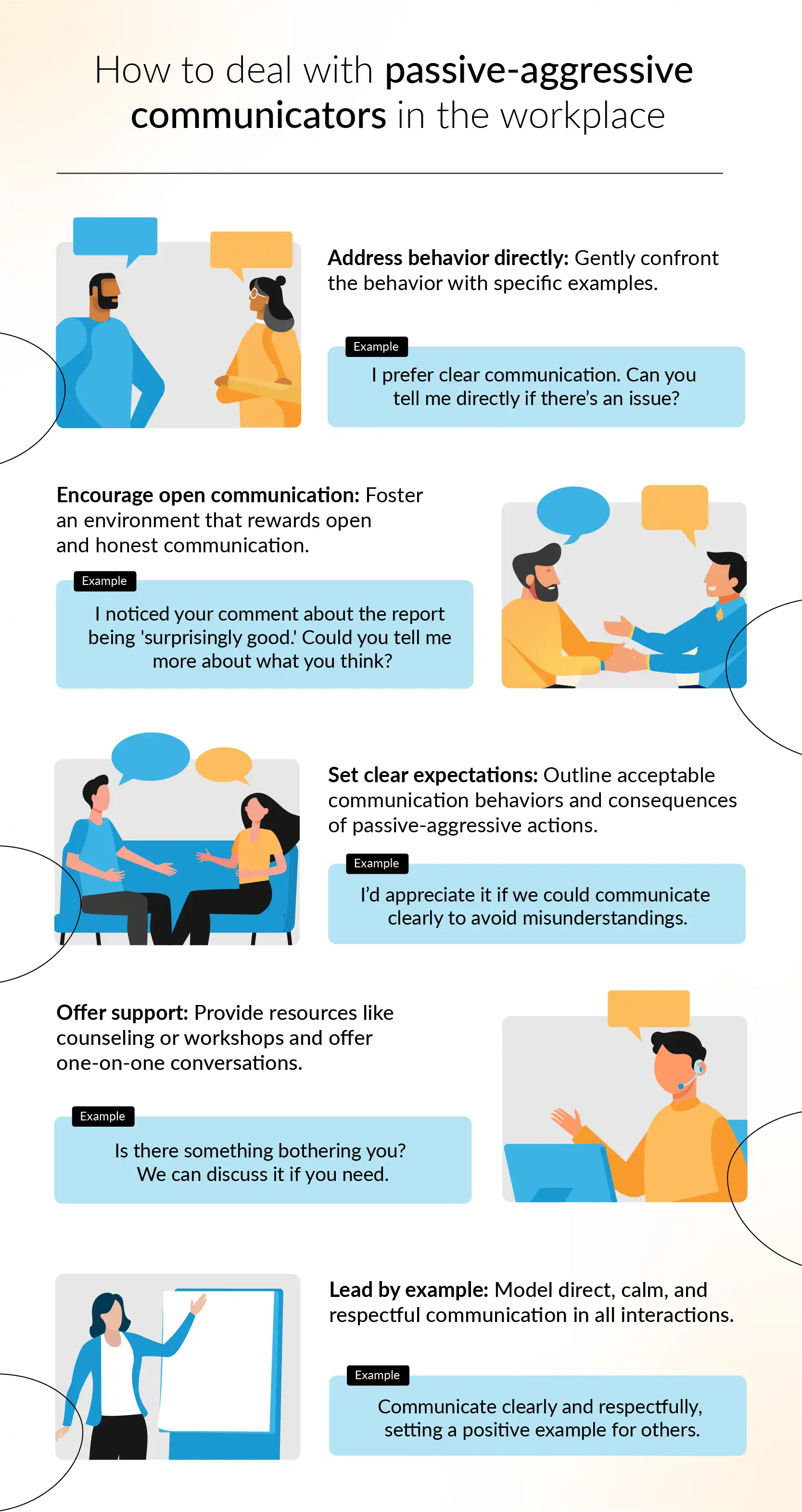
When you encounter passive-aggressive communication, it’s essential to address it constructively. Below are some strategies that may help you respond effectively.
Address behavior directly: Gently confront the behavior without being harsh. Use specific examples and express how it affects you and the team.
Example:
I prefer clear communication. Can you tell me directly if there’s an issue?
Encourage open communication: Foster an environment where open and honest communication is encouraged and rewarded.
Example:
I noticed your comment about the report being 'surprisingly good.' Could you tell me more about what you think?
Set clear expectations: Clearly outline acceptable communication behaviors and the consequences of passive-aggressive actions.
Example:
I’d appreciate it if we could communicate openly and honestly to avoid misunderstandings.
Offer support: Provide resources such as counseling or communication workshops to help employees constructively express themselves. In an individual capacity also, you can offer one-on-one conversation to help a colleague cope with his/her negative feelings.
Example:
Is there something bothering you? We can discuss it if you need.
Lead by example: Leaders must model direct and respectful communication in their interactions. As a leader, you must strive to communicate clearly and respectfully, setting a positive example. Some tips that can help you to do so are:
Passive-aggressive communication can be a significant barrier to effective interaction and collaboration in both personal and professional settings. Recognizing and transforming passive-aggressive behaviors is crucial for personal growth and building stronger, more transparent relationships.
You can work to develop a more assertive communication style by focusing on a few key points. Here are some essential steps you can take to improve effective communication skills:
Prezent is your AI coach that can help you deal with passive-aggressive communicators and reply appropriately by refining your assertive communication style, thereby enabling you to be more effective and productive. You can benefit from the following features of Prezent:
Prezent’s comprehensive features assist you in effectively managing passive-aggressive communication and developing a more assertive and impactful communication style. Since most professionals are not formally trained in communication, Prezent enables them to enhance their workplace interactions without impacting the organizational budget.
Discover more extraordinary features of Prezent by scheduling a demo and see how it can help you and your team in effective business communication and building exceptional presentations every time. You can also explore the platform yourself by taking advantage of the free trial.










.png)