No items found.
No items found.
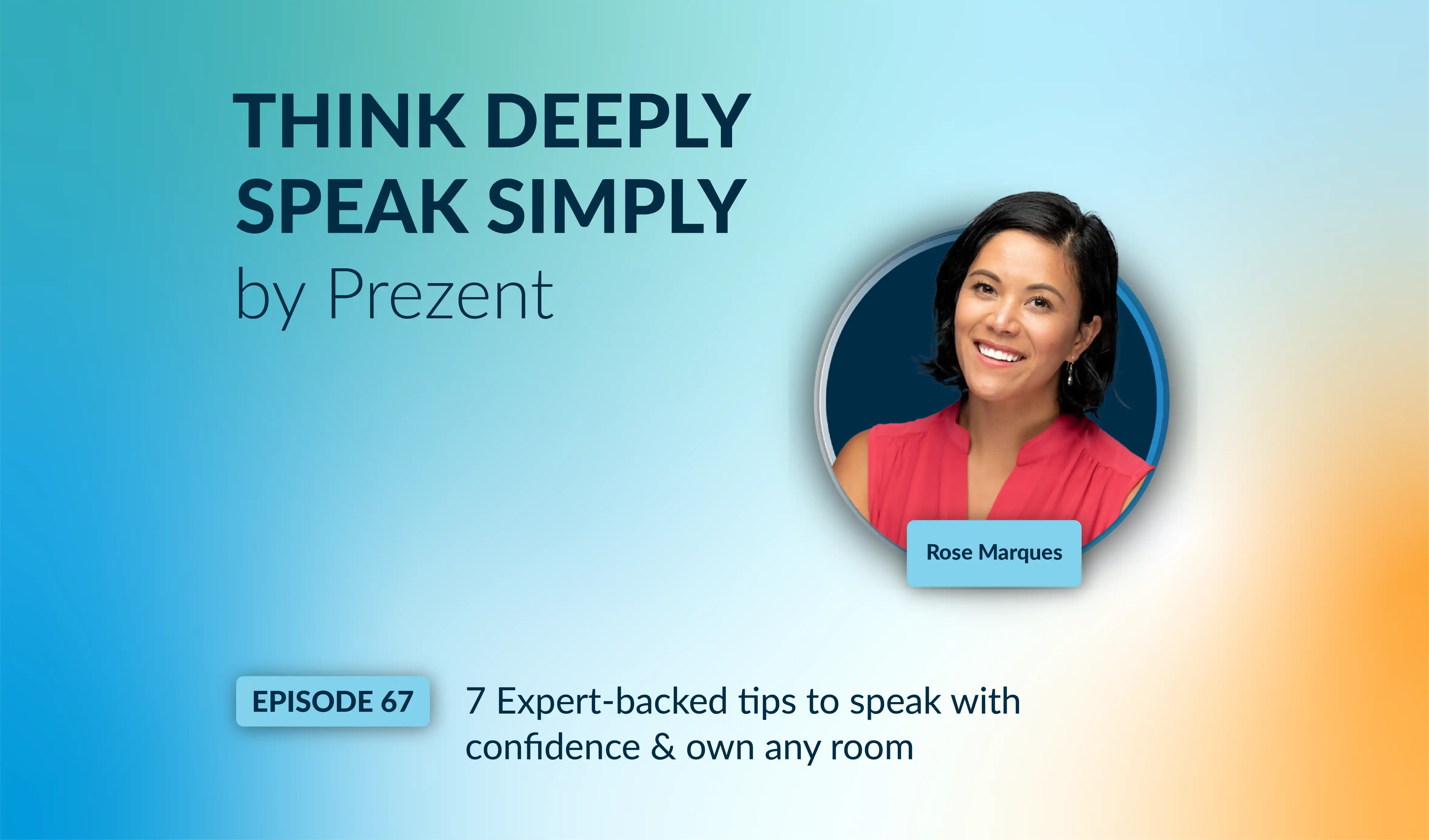
The best public speakers make it look easy. Barack Obama, Tony Robbinson, Brene Brown – they all seem completely comfortable speaking in front of thousands of people.
But, according to communication coach Rose Choi Marquez, the best communicators weren’t born that way. They practiced, refined, and developed their skills over time in order to gain the confidence needed to truly engage their audience.
“Confidence is believing in yourself and believing in what you're saying,” she says. “It's not something you're born with. It’s something you can build, just like any other skill.”
In our latest episode of the Think Deeply, Speak Simply podcast, Rose breaks down how anyone—yes, anyone—can train themselves to own any room if they have the right tools to navigate nerves and command attention.
Whether you’re pitching to execs, leading a team, or just want to stop second-guessing yourself, these tips will transform how you communicate.
Here are Rose’s top tips:
1. Take a deep breath. Really.
Yes, this may sound a bit cliche, but according to Rose your breath is your secret weapon when it comes to communicating impactfully.
“The first tip I always give is to breathe,” she says. “It’s the core of any speaking. When you take a breath, it settles your nerves, slows you down, and physically lowers your heart rate.”
If you can slow yourself down, you’ll sound more composed, more authoritative, and more in control.
So before you speak, try this: Pause. Inhale slowly through your nose for four seconds. Hold for four seconds. Exhale slowly for four seconds. Repeat this twice before speaking.
“People think pausing to breathe feels awkward, but it’s not,” says Rose. “To your audience, it just makes you look more composed.”
2. Find your anchors in the room
Another way to fight those nerves is to find your anchors in the room. Instead of staring into a sea of faces, find one or two engaged listeners—the people who are nodding and smiling at what you’re saying.
“The best speakers make you feel like they’re talking directly to you,” says Rose. “That’s because they are—they find one or two people in the room and use them as their energy source.”
Not only does this help ground you but it also helps you create connections and make your message more compelling. Seeing someone smile or nod gives you real-time feedback, reassuring you that your message is landing.
“Every time you look at them, you get a little boost of confidence,” says Rose. “It feels less like you’re performing and more like a conversation.”
Pro tip: If you’re on a video call, pick one or two faces on the screen and direct your energy there.
3. Take up space
Rose introduces a simple yet powerful technique that can shift your mindset from trying to be invisible to confidently owning the room. Many of us may have experienced moments when we shrink while speaking, especially in times of anxiety. This is something we may even do ourselves.
Rose explains, “If you shrink, people subconsciously see you as less authoritative.” On the other hand, adopting open and active body language while speaking will not only make you appear more confident to your audience, but it will also naturally boost your own confidence.
“When you expand, you feel more confident—and others see you that way too,” says Rose.
4. Use vocal variety—avoid the monotone trap
Vocal variety plays a crucial role in keeping an audience engaged during a speech. Think back to those monotonous lectures that left you struggling to stay awake—perfect examples of how a lack of vocal variation can make even the most important message uninteresting.
“People don’t realize that 70% of communication is nonverbal. It’s not just what you say—it’s how you say it,” explains Rose. Effectively using vocal variety—such as tone, volume, and strategic pauses—can help you get people’s attention.. “Great speakers use pace, inflection, and volume to keep the audience engaged,” adds Rose Choi Marquez.
These subtle yet powerful techniques can help make your speeches more compelling and memorable.
5. Write down your wins for a confidence boost
To help yourself feel more confident before a presentation, Rose recommends a simple yet effective habit: write down 2-3 of your accomplishments that you are proud of and place them somewhere you can see them every day. visible.
“People spend too much time thinking about what could go wrong,” says Rose. “But if you remind yourself of what you’ve already done, it shifts your mindset. Instead of, ‘I hope I don’t mess up,’ you think, ‘I’ve handled things like this before—I got this.’”
This technique not only helps your brain focus on past successes but also gradually strengthens your confidence.“It’s a reminder: ‘I’ve done hard things before. I can do this too,” says Rose.
6. Speak up when you feel the urge
We've all experienced that moment when we want to speak but, for some reason, we hesitate.
“We all have those moments where we think, ‘Should I say this? What if it’s not perfect? What if no one agrees?’” says Rose. “But what if it adds value? What if it changes the conversation? You’ll never know unless you speak up.””
Rose encourages everyone to trust their instincts and speak up when they have something valuable to contribute.
By breaking free from overthinking and stepping out of your comfort zone, you’ll actually significantly boost your confidence over time. “The more you practice using your voice, the easier it gets,” adds Rose Choi Marquez.
7. Practice, don’t wing it
It may be cliché, but practice really does make perfect.
“The best speakers sound effortless because they put in the time to refine their message,” says Rose. “The more prepared you are, the less you have to rely on ‘confidence’—because you’ll know you’re ready.”
But practicing isn’t memorizing—it’s refining. “Practicing isn’t just repeating your speech in your head. It’s about rehearsing it out loud, testing your delivery, and making adjustments,” she says. Even five minutes of practice can sharpen your message, smooth out awkward phrasing, and boost your clarity.
And if you’re short on time? “If you only have time to practice one thing, practice your first 30 seconds. That opening sets the tone for everything else,” says Rose.
Final takeaway: Confidence is built, not born
Confidence in public speaking isn’t something you’re born with—it’s something you build. With the right techniques, consistent practice, and a willingness to push past discomfort, anyone can learn to own the room.
As Rose puts it, “You’ve already stepped out of your comfort zone before. You can do it again.”
Try these tactics before your next meeting, pitch, or conversation and notice the shift in how you feel – and how people respond.
Where you can watch or listen
Our podcasts are easily accessible on our YouTube channel. You can also listen on the go via your favorite platforms, including Spotify and Apple Podcasts.


.png)