No items found.
No items found.

The manufacturing industry has always demanded speed, precision, and efficiency. But today, the most significant challenges often start not on the factory floor but in the flow of information. A machine stalls, a manufacturing process slows, numbers shift, and by the time data is pulled and analyzed, the chance to act is already gone.
The problem is not a lack of information. Plants now collect endless data from MES, ERP, IoT sensors, and CRMs. The real issue is timing and clarity. Insights often arrive too late or in formats that are hard to use. Teams lose hours chasing metrics and patching spreadsheets while problems continue to grow.
This is where artificial intelligence is making a difference. AI tools do more than crunch numbers. They enable predictive maintenance, adapt to real-time conditions, and deliver insights leaders can act on instantly. For manufacturers, this means spotting risks earlier, optimizing processes on the fly, and communicating performance across the business with greater clarity.
In this blog, we look at eight AI-powered solutions helping manufacturers reduce costs, stay resilient, and run smarter operations. Let’s dive in.
AI is reshaping manufacturing because it learns, adapts, and improves continuously. Modern factories face fragile supply chains, tighter timelines, and unpredictable demand, all while being asked to cut costs and maintain quality. Traditional systems cannot keep up with this pace.
Manufacturing AI helps by predicting equipment issues before they lead to downtime, identifying bottlenecks, optimizing energy use, and providing clear, data-backed recommendations instead of overwhelming dashboards. The result is faster decisions, higher-quality output, and more efficient operations.
Key drivers of adoption include:
In short, AI enables manufacturers not only to run operations but to keep improving them.
Factories now generate more data than ever, yet downtime still slips through, quality issues escalate, and reporting often takes longer than the fixes themselves.
The eight tools we highlight here represent the most effective manufacturing AI solutions available in 2025. Each addresses a critical challenge, whether it is predictive maintenance, process optimization, supply chain stability, or making complex performance metrics clear enough for leaders to act on.
Manufacturing leaders juggle massive amounts of data daily: production metrics, quality results, supply chain updates, and plant performance dashboards. But when it’s time to share that information with executives, plant managers, or external stakeholders, the real challenge begins. Reports take too long to prepare, formatting slows decisions, and inconsistent slides dilute the message.
Prezent solves this problem. It’s an enterprise-grade generative AI presentation maker designed to help manufacturing teams transform raw operational data into clear, on-brand, and decision-ready presentations. At its core is Astrid, Prezent’s contextual intelligence AI, which takes inputs like spreadsheets, KPI dashboards, or process reports and instantly structures them into polished presentations aligned with your company’s brand and audience expectations.
By reducing time spent on formatting and presentation prep, Prezent gives manufacturing teams the space to focus on what really matters: improving efficiency, reducing downtime, and aligning stakeholders around data-driven decisions.

Prezent addresses one of the manufacturing industry’s most overlooked challenges: communication. While most manufacturing AI tools focus on optimizing machines or supply chains, Prezent ensures the insights from those tools don’t get lost in translation. It helps teams move from raw data to decisions by delivering presentations that are fast, accurate, and on-brand.
Manufacturers that adopt Prezent can reduce reliance on agencies, speed up reporting cycles, and align global teams around the same story. In an industry where every delay can mean lost output or wasted resources, Prezent gives leaders the confidence to present complex insights clearly and act quickly.
Schedule a demo and see why Prezent is the ultimate manufacturing presentation software that can help your manufacturing team save time, cut rework, and deliver presentations that move operations forward.
Manufacturing loses millions to unexpected downtime every year, especially when assets fail without warning. Augury harnesses machine learning algorithms and acoustic sensing to keep manufacturing equipment healthy, alerting teams to early-stage faults and reducing surprise stoppages.
At its core, the platform captures subtle vibration and sound data from motors, bearings, and compressors to learn what “normal” sounds like. When that pattern shifts, it sends an alert with a visual diagnostic dashboard that traces the likely cause so maintenance can act before an unplanned line stop.

Unexpected downtime disrupts manufacturing like nothing else. Augury gives operations leaders clarity into asset health before failure occurs, saving both hours on the floor and repair costs. Its visual diagnostics empower teams to act with confidence and keep production flowing.
Avathon, previously known as SparkCognition, focuses on applying advanced industrial AI to improve safety, reliability, and efficiency in manufacturing. Its AI-driven solutions help teams predict equipment risks, optimize energy usage, and prevent incidents before they disrupt production. With its rebrand, Avathon emphasizes combining deep domain expertise with cutting-edge AI models designed for heavy industry and manufacturing environments.

Avathon is a trusted name in industrial AI, building on SparkCognition’s legacy while expanding into a broader platform for manufacturers. Its focus on predictive insights, sustainability, and safety makes it a valuable choice for organizations seeking to reduce downtime and risks while improving operational efficiency.
Uptake specializes in asset performance management (APM), helping manufacturers keep equipment running at peak efficiency. Its AI platform ingests machine, sensor, and maintenance data to generate predictive insights on equipment health, resource use, and productivity.

Uptake brings clarity to complex asset ecosystems. With its predictive insights, manufacturers reduce unplanned downtime, increase reliability, and save on repair and replacement costs. It’s especially powerful for companies managing large fleets of heavy machinery or distributed plants.
Maintenance teams often have no shortage of approved work orders. The real challenge begins after approval, when planners must turn a long backlog into a realistic, executable schedule. Too often, that process depends on spreadsheets, manual adjustments, and disconnected planning tools that fail to reflect actual labor capacity.
Sockeye addresses this gap. It is a maintenance scheduling platform that integrates directly with existing CMMS and EAM systems, helping teams convert approved work into optimized, achievable schedules.
Rather than replacing your current systems, Sockeye strengthens them. Through direct integration, it pulls ready-to-plan work orders and applies intelligent scheduling logic based on technician availability, job priority, required skill sets, and resource constraints. The result is a clear, real-time visual schedule that improves preventive maintenance compliance and maximizes workforce productivity.
By eliminating manual coordination and static spreadsheets, Sockeye enables maintenance leaders to move from reactive planning to disciplined execution.
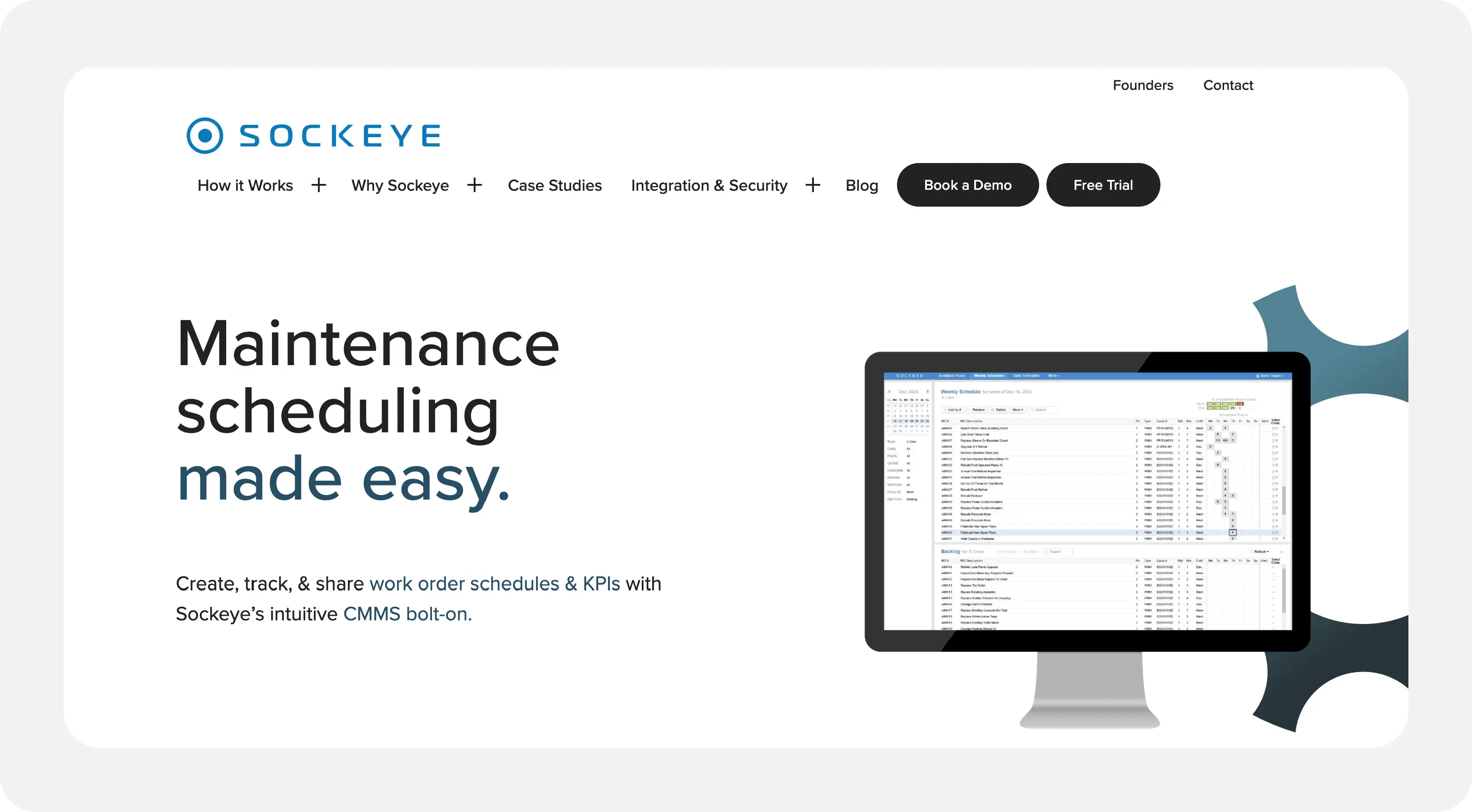
Sockeye solves one of maintenance operations’ most persistent challenges: execution. While many tools focus on asset monitoring or predictive insights, Sockeye ensures approved work is scheduled realistically and completed on time. Its intelligent automation strengthens planning discipline, improves schedule compliance, and drives measurable gains in productivity.
Braincube is an Industrial IoT (IIoT) platform that connects machines, sensors, and production systems into one unified digital layer. It uses AI to provide actionable insights, optimize processes, and reduce waste, all in real time.

Braincube turns raw machine data into actionable intelligence. It’s designed for real-world operations, with practical dashboards and pre-built tools that make adoption easier. Manufacturers use it to move from reactive problem-solving to proactive improvement.
SymphonyAI Industrial delivers sector-specific AI solutions that focus on production optimization, supply chain visibility, and quality assurance. Building on the SymphonyAI group’s expertise, its platform provides manufacturers with tailored insights for reducing waste and improving productivity.

SymphonyAI Industrial stands out for its manufacturing industry-specific focus. Rather than offering generic AI capabilities, it’s designed to solve manufacturing’s unique challenges—from supply chain volatility to on-line quality. Its modular approach also makes it adaptable to companies at different stages of AI maturity.
Tulip is a no-code smart factory platform that allows manufacturers to digitize and optimize shop floor operations quickly. It combines enterprise AI with easy-to-build applications, so teams can improve workflows without heavy IT involvement.

Tulip empowers operators and engineers to solve problems themselves, without waiting for IT or external vendors. It’s one of the most flexible platforms for digitizing and optimizing factory operations, making manufacturing AI adoption faster and more practical on the ground.
Manufacturers know that efficiency isn’t just about machines—it’s also about energy. Plants are under constant pressure to reduce operating costs while meeting sustainability targets. Schneider Electric’s EcoStruxure Industrial Advisor brings AI-driven energy and process optimization into the factory, giving leaders a clear way to balance productivity with cost and environmental impact.
By analyzing data from equipment, utilities, and production lines, EcoStruxure identifies patterns of waste, recommends corrective actions, and can even automate adjustments. The result is measurable reductions in energy usage and carbon emissions—without disrupting output. For energy-intensive industries like chemicals, semiconductors, or heavy manufacturing, this can be a game-changer.

Energy is one of the biggest cost drivers in manufacturing and one of the hardest to control. EcoStruxure Industrial Advisor provides the intelligence leaders need to cut waste and optimize energy usage, all while staying aligned with corporate sustainability commitments. It’s a strong complement to other enterprise AI tools focused on production and asset performance, tackling the resource side of manufacturing operations with equal precision.
AI is no longer a side experiment in the manufacturing industry; it’s becoming the foundation for smarter operations. From predictive maintenance that prevents costly breakdowns to energy optimization platforms that cut waste in the manufacturing process, today’s AI tools give manufacturers the ability to respond faster, operate leaner, and maintain consistent quality under pressure. The real advantage lies in how these solutions turn raw data into practical actions that improve day-to-day performance.
But even the most advanced manufacturing AI insights lose their impact if they aren’t communicated clearly. That’s where Prezent stands apart. While other platforms optimize machines, workflows, or energy, Prezent helps manufacturing teams share their results with the people who matter: executives, regulators, and stakeholders. By transforming complex performance metrics into polished, on-brand presentations, Prezent ensures decisions aren’t delayed by formatting bottlenecks or misaligned messaging.
Manufacturers who embrace both operational AI and communication AI gain a decisive edge. They not only run more efficient plants but also align faster, act with greater confidence, and build trust across their organizations. If you want your teams to focus less on slides and more on strategy, Prezent is the AI partner to consider.
Schedule a demo and see how Prezent can help your manufacturing teams present with clarity, speed, and confidence.

Bharti is a product marketing writer at Prezent who believes great writing starts with deep reading. She began her career in finance, switched paths in 2019, and has since worked with Kintegra, Clearout, Miko, CaratLane, and, of course, Prezent. From content marketing to product marketing, she enjoys simplifying complex product and technical ideas without losing meaning. As she always says, “If it needs explaining twice, it needs better writing.”
Connect with her on LinkedIn.